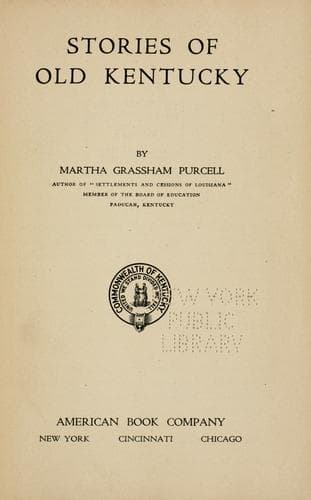
Stories of Old KentuckyPurcell, Martha C. Grassham, Mrs.
History
Stories of Old Kentucky
Purcell, Martha C. Grassham, Mrs.
Kentucky -- History
Spain and France for years were zealous in their efforts to check the
extension of the infant republic, control the great Mississippi, and
make of Kentucky a Spanish province. Her geographical position and great
river frontage caused them to realize her wonderful resources. So, to
fortify the claim of the United States to the Mississippi as its western
boundary, Thomas Jefferson, Governor of Virginia, engaged Dr. Thomas
Walker with an able corps of surveyors to ascertain the point on the
Mississippi River intersected by the southern limit of Virginia. He
then, in 1780, instructed General George Rogers Clark to establish a
fort and garrison near that point and afterwards to extend a line of
forts to the north, both to offer protection and to establish
possession. So in the summer of 1780, General Clark with 200 soldiers
erected and manned with cannons a fort at a point about five miles below
where Cairo now is and near Wickliffe, Kentucky. Adverse criticisms fell
from many because of this division and depletion of forces, but as in
all other enterprises with which he was connected, Jefferson built not
for the present alone but for the future as well.
By an oversight Clark and his soldiers failed to follow Jefferson's
instructions to secure from the Chickasaw Indians, who owned the land
west of the Tennessee River, the consent to the erection of the fort.
They thereby aroused a spark of resentment that erelong became such a
flame that the Indians began harassing and killing the families outside
the fort. By threat of death, they forced one captive to describe the
true state of the fort, in which, to their surprise, they learned there
were only about thirty men and two thirds of these were sick with
malaria. Soon the Indians marched, one thousand two hundred strong,
under the command of a Scotchman named Colbert; but for five days these
weakened frontiersmen with little water and less food, except green
pumpkins, held the fort.
Finally Captains Clark and Colbert met under a flag of truce, but failed
to agree to terms. The fort even refused a demand to surrender, though
told that the assistance they expected would not reach them. As night
fell the Indians made a desperate assault, but the firing from one of
the blockhouses so depleted and demoralized their ranks that they
retreated. Reënforcements arrived soon after and the siege was
abandoned.
Though Fort Jefferson from its isolated position was finally forsaken,
yet "its evacuation was a signal for peace," and the Indians here no
longer molested the white settlers.
"THE HARD WINTER"
From November to March, 1779-1780, the settlers of Kentucky suffered
untold anguish from the severity of the weather and the scarcity of
food. More pioneers had come into the wilderness the preceding summer
and so increased the population that the products of garden, field, and
forest were soon exhausted.
Public-domain text, read in full here on John Shaqi.
Reviews
Reviews
No reviews yet
Be the first to share your thoughts on this work.
Join the Discussion
Join the discussion
Sign in to leave a comment or review.
Sign InorCreate an account