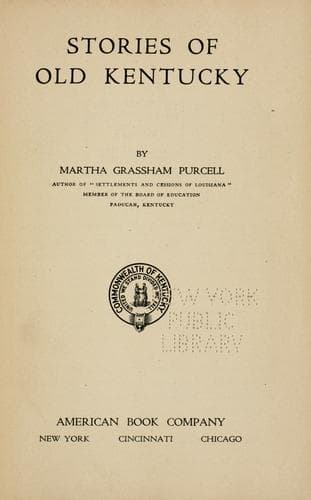
Stories of Old KentuckyPurcell, Martha C. Grassham, Mrs.
History
Stories of Old Kentucky
Purcell, Martha C. Grassham, Mrs.
Kentucky -- History
Deep, unmelting snow covered the land; many families coming by river
were caught in the masses of ice, compelled to abandon their primitive
boats, and encamp on the frozen shore; while the traveler by land found
trails blocked with snow, creeks frozen solid, and the forest desolate.
Horses, cattle, and many wild animals froze or died from want of
nourishment, while so great was the extremity that the settlers were
forced to eat the flesh of the animals that had thus fallen, and for
months had to go without bread. In this severe cold, through the deep
snow and over the solid ice, there could be little traveling. To secure
supplies from elsewhere was impossible; and even when spring began to
bring some relief, one bushel of corn brought, in the continental
currency, from fifty to one hundred and seventy-five dollars. Complete
relief could not come until the seedtime and the harvest home were over.
The Pilgrims were not more grateful on their first Thanksgiving Day than
were the Kentucky frontiersmen when plenty again abounded.
WILDCAT McKINNEY
Though the pioneers of Kentucky endured many murderous attacks from the
Indians, there were other dangers which were not trifling. One of the
most exciting of these incidents was the experience of a man named John
McKinney, who was employed at an early day by the people of Lexington,
as their first teacher.
At that time Kentucky had no newspaper, and items of interest from the
states beyond the mountains were eagerly greeted by all. In May, 1783, a
traveler passing through the embryo city of what is now the capital of
our famed blue-grass section, brought with him a newspaper containing
the Articles of Peace with Great Britain. All were anxious to read them.
The fact that the Articles had not yet been ratified did not lessen the
interest of the citizens. A copy of any paper was a treat, and such news
as the Articles meant great hope for the struggling settlers. As the
gentleman would resume his journey the following day and take with him
the much-prized paper, some of the citizens appealed to McKinney to copy
the Articles of Peace.
At that time Lexington was only a cluster of about thirty cabins, and
one which stood just outside the fort, near the present site of the
courthouse, was used as a schoolroom.
Thither, the next morning, the teacher went to copy the precious news of
peace. While busily writing, he heard a noise and glancing up saw a
very unusual and unwelcome guest. A ferocious wildcat with bristles
erect, tail curled, and eyes flashing, had paused on the threshold and
was peering around the room. At first she did not see McKinney, but by
some involuntary movement he attracted her attention, and she soon
exhibited other than friendly emotions.
[Illustration: "The wildcat was not to be frowned down."]
Public-domain text, read in full here on John Shaqi.
Reviews
Reviews
No reviews yet
Be the first to share your thoughts on this work.
Join the Discussion
Join the discussion
Sign in to leave a comment or review.
Sign InorCreate an account