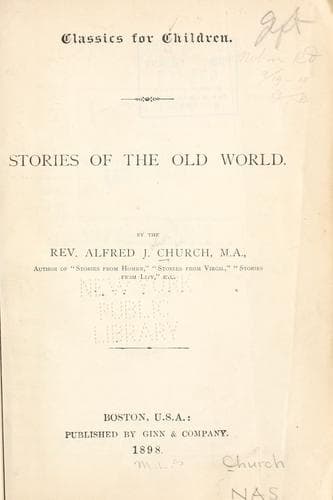
Mythology, Greek -- Juvenile literature; Mythology, Roman -- Juvenile literature
So the guard departed; but as he went he said to himself, “Now may the
Gods grant the man be found; but however this may be, thou shalt not
see me come again on such errand as this, for even now have I escaped
beyond all hope.” Notwithstanding, after a space he came back with one
of his fellows; and they brought with them the maiden Antigone, with
her hands bound together. And it chanced that at the same time King
Creon came forth from the palace. Then the guard set forth the thing
to him, saying, “We cleared away the dust from the dead body, and sat
watching it. And when it was now noon, and the sun was at his height,
there came a whirlwind over the plain, driving a great cloud of dust.
And when this had passed, we looked, and lo! this maiden whom we have
brought hither stood by the dead corpse. And when she saw that it lay
bare as before, she sent up an exceeding bitter cry, even as a bird
whose young ones have been taken from the nest. Then she cursed them
that had done this deed; and brought dust and sprinkled it upon the
dead man, and poured water upon him three times. Then we ran and laid
hold upon her, and accused her that she had done this deed; and she
denied it not. But as for me, ’tis well to have escaped from death,
but it is ill to bring friends into the same. Yet I hold that there is
nothing dearer to a man than his life.”
Then said the King to Antigone, “Tell me in a word, didst thou know my
decree?”
“I knew it. Was it not plainly declared?”
“How daredst thou to transgress the laws?”
“Zeus made not such laws, nor Justice that dwelleth with the Gods
below. I judged not that thy decrees had such authority that a man
should transgress for them the unwritten sure commandments of the Gods.
For these, indeed, are not of to-day or yesterday, but they live for
ever, and their beginning no man knoweth. Should I, for fear of thee,
be found guilty against them? That I should die I knew. Why not? All
men must die. And if I die before my time, what loss? He who liveth
among many sorrows, even as I have lived, counteth it gain to die. But
had I left my own mother’s son unburied, this had been loss indeed.”
Then said the King, “Such stubborn thoughts have a speedy fall, and
are shivered even as the iron that hath been made hard in the furnace.
And as for this woman and her sister,--for I judge her sister to have
had a part in this matter,--though they were nearer to me than all my
kindred, yet shall they not escape the doom of death. Wherefore let
some one bring the other woman hither.”
And while they went to fetch the maiden Ismené, Antigone said to the
King, “Is it not enough for thee to slay me? What need to say more? For
thy words please me not nor mine thee. Yet what nobler thing could I
have done than to bury my own mother’s son? And so would all men say
but fear shutteth their mouths.”
Public-domain text, read in full here on John Shaqi.
Reviews
Reviews
No reviews yet
Be the first to share your thoughts on this work.
Join the Discussion
Join the discussion
Sign in to leave a comment or review.
Sign InorCreate an account