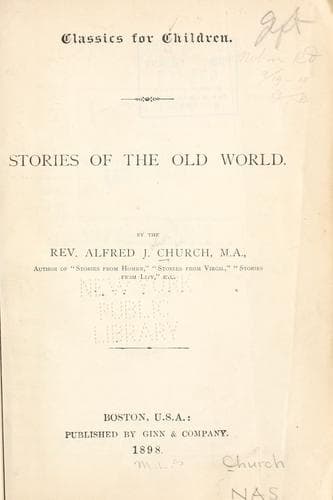
Mythology, Greek -- Juvenile literature; Mythology, Roman -- Juvenile literature
“Nay,” said the King, “none of the children of Cadmus thinketh thus,
but thou only. But, hold, was not he that fell in battle with this man
thy brother also?”
“Yes, truly, my brother he was.”
“And dost thou not dishonor him when thou honorest his enemy?”
“The dead man would not say it, could he speak.”
“Shall then the wicked have like honor with the good?”
“How knowest thou but that such honor pleaseth the Gods below?”
“I have no love for them I hate, though they be dead.”
“Of hating I know nothing; ’tis enough for me to love.”
“If thou wilt love, go love the dead. But while I live no woman shall
rule me.”
Then those that had been sent to fetch the maiden Ismené brought her
forth from the palace. And when the King accused her that she had been
privy to the deed, she denied not, but would have shared one lot with
her sister. But Antigone turned from her, saying, “Not so; thou hast no
part or lot in the matter. For thou hast chosen life, and I have chosen
death; and even so shall it be.” And when Ismené saw that she prevailed
nothing with her sister, she turned to the King and said, “Wilt thou
slay the bride of thy son?”
“Aye,” said he, “there are other brides to win!”
“But none,” she made reply, “that accord so well with him.”
“I will have no evil wives for my sons,” said the King.
Then cried Antigone, “O Hæmon, whom I love, how thy father wrongeth
thee!”
Then the King bade the guards lead the two into the palace. But
scarcely had they gone when there came to the palace the Prince Hæmon,
the King’s son, who was betrothed to the maiden Antigone. And when the
King saw him, he said, “Art thou content, my son, with thy father’s
judgment?”
And the young man answered, “My father, I would follow thy counsels in
all things.”
Then said the King, “’Tis well spoken, my son. This is a thing to
be desired, that a man should have obedient children. But if it be
otherwise with a man, he hath gotten great trouble for himself, and
maketh sport for them that hate him. And now as to this matter. There
is nought worse than an evil wife. Wherefore I say, let this damsel
wed a bridegroom among the dead. For since I have found her, alone of
all this people, breaking my decree, surely she shall die. Nor shall
it profit her to claim kinship with me, for he that would rule a city
must first deal justly with his own kindred. And as for obedience,
this it is that maketh a city to stand both in peace and in war!”
To this the Prince Hæmon made answer, “What thou sayest, my father,
I do not judge. Yet bethink thee, that I see and hear on thy behalf
what is hidden from thee. For common men cannot abide thy look if they
say that which pleaseth thee not. Yet do I hear it in secret. Know
then that all the city mourneth for this maiden, saying that she dieth
wrongfully for a very noble deed, in that she buried her brother. And
’tis well, my father, not to be wholly set on thy own thoughts, but
listen to the counsels of others.”
Public-domain text, read in full here on John Shaqi.
Reviews
Reviews
No reviews yet
Be the first to share your thoughts on this work.
Join the Discussion
Join the discussion
Sign in to leave a comment or review.
Sign InorCreate an account