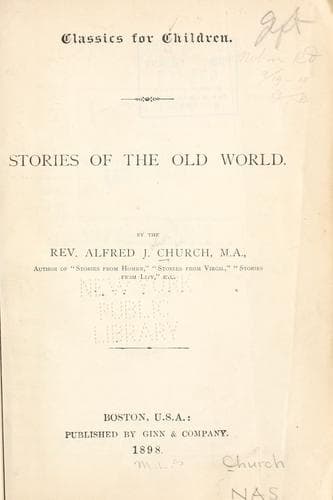
Mythology, Greek -- Juvenile literature; Mythology, Roman -- Juvenile literature
“Nay,” said the King; “shall I be taught by such an one as thou?”
“I pray thee regard my words, if they be well, and not my years.”
“Can it be well to honor them that transgress? And hath not this woman
transgressed?”
“The people of this city judgeth not so.”
“The people, sayest thou! Is it for them to rule, or for me?”
“No city is the possession of one man only.”
So the two answered one the other, and their anger waxed hot. And at
the last the King cried, “Bring this accursed woman, and slay her
before his eyes.”
And the Prince answered, “That thou shalt never do. And know this also,
that thou shalt never see my face again.”
So he went away in a rage; and the old men would have appeased the
King’s wrath, but he would not hearken to them, but said that the two
maidens should die. “Wilt thou then slay them both?” said the old men.
“’Tis well said,” the King made answer. “Her that meddled not with the
matter I harm not.”
“And how wilt thou deal with the other?”
“There is a desolate place, and there I will shut her up alive in a
sepulchre; yet giving her so much of food as shall quit us of guilt
in the matter, for I would not have the city defiled. There let her
persuade Death, whom she loveth so much, that he harm her not.”
So the guards led Antigone away to shut her up alive in the sepulchre.
But scarcely had they departed when there came the old prophet
Tiresias, seeking the King. Blind he was, so that a boy led him by the
hand; but the Gods had given him to see things to come. And when the
King saw him he asked, “What seekest thou, wisest of men?”
Then the prophet answered, “Hearken, O King, and I will tell thee. I
sat in my seat, after my custom, in the place whither all manner of
birds resort. And as I sat I heard a cry of birds that I knew not,
very strange and full of wrath. And I knew that they tare and slew
each other, for I heard the fierce flapping of their wings. And being
afraid, I made inquiry about the fire, how it burned upon the altars.
And this boy, for as I am a guide to others so he guideth me, told
me that it shone not at all, but smouldered and was dull, and that
the flesh which was burnt upon the altar spluttered in the flame, and
wasted away into corruption and filthiness. And now I tell thee, O
King, that the city is troubled by thy ill counsels. For the dogs and
the birds of the air tear the flesh of this dead son of Œdipus, whom
thou sufferest not to have due burial, and carry it to the altars,
polluting them therewith. Wherefore the Gods receive not from us prayer
or sacrifice; and the cry of the birds hath an evil sound, for they
are full of the flesh of a man. Therefore I bid thee be wise in time.
For all men may err; but he that keepeth not his folly, but repenteth,
doeth well; but stubbornness cometh to great trouble.”
Public-domain text, read in full here on John Shaqi.
Reviews
Reviews
No reviews yet
Be the first to share your thoughts on this work.
Join the Discussion
Join the discussion
Sign in to leave a comment or review.
Sign InorCreate an account