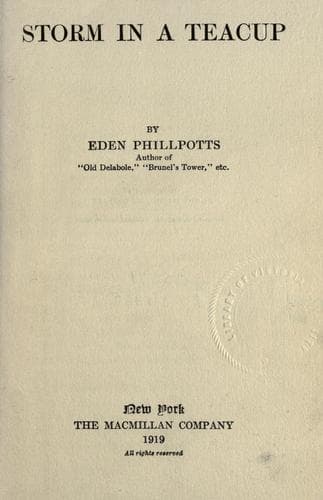
Devon (England) -- Fiction; Husband and wife -- Fiction; Man-woman relationships -- Fiction; Paper mills -- Fiction
Now, on Sunday afternoon, Lydia, at the garden gate of her brother’s
house, started off six children to Sunday school. Five were girls and
one was a boy. They ranged from twelve years old to three; while at
home a two year old baby—another girl—remained with her mother. Mary
Dolbear expected her tenth child during the coming spring. Two had died
in infancy. She was an inert, genial mass of a woman, who lived only
for her children and the business of maternity. Her husband worshipped
her and they increased and multiplied proudly. Their house, but for
Lydia’s sleepless ministrations, would have been a pigstye. They were
indifferent to dirt and chose to make all things subservient to the
demands of their children.
“The cradle rules the world, so enough said,” was Tom Dolbear’s
argument when people protested at the chaos in which he lived. He was
a stout man with a fat, boyish face, scanty, sandy hair and a narrow
forehead, always wrinkled by reason of the weakness of his eyes. He had
a smile like a baby and was indeed a very childish man; but he knew his
business and made his farm suffice for his family needs.
In this house Lydia’s own room was an oasis in a wilderness. There one
found calm, order, cleanliness, distinction. She trusted nobody in it
but herself and always locked the door when she left for work.
It was regarded as a sacred room, for both Mary and her husband
reverenced Lydia and blessed the Providence that had sent her to them.
They treated her with the greatest respect, always gave way to her and
recognised very acutely the vital force she represented in the inert
and sprawling domesticity of their establishment. Once, when an idea
was whispered that Tom’s sister might leave him, Mary fell absolutely
ill and refused to eat and drink until she changed her mind and
promised to stay.
To do them justice they never took Lydia for granted. Their gratitude
flowed in a steady stream. They gave her all credit and all admiration,
and went their philoprogenitive way with light hearts.
Now Mrs. Trivett watched her nieces and nephew march together in their
Sunday best along the way to Sunday school. Then she was about to shut
the wicket and return up the garden path, when a man appeared on the
high road and a fellow worker at the Mill accosted her.
Nicholas Pinhey was a finisher; that is to say the paper passed
through his hands last before it left the works. With the multifarious
processes of its creation he had nothing to do; but every finished
sheet and stack of sheets touched his fingers before it entered the
world, and he was well skilled in the exacting duties of his own
department.
Public-domain text, read in full here on John Shaqi.
Reviews
Reviews
No reviews yet
Be the first to share your thoughts on this work.
Join the Discussion
Join the discussion
Sign in to leave a comment or review.
Sign InorCreate an account