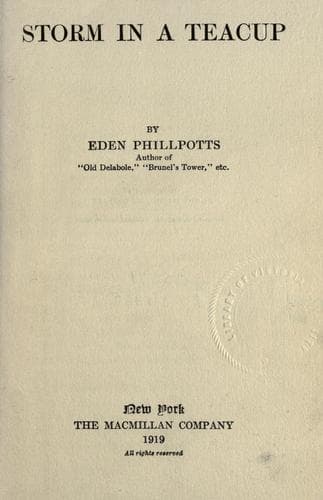
Devon (England) -- Fiction; Husband and wife -- Fiction; Man-woman relationships -- Fiction; Paper mills -- Fiction
“And keep its head above water,” added the listener.
Matthew Trenchard eyed him doubtfully and lighted another cigarette.
“Yes,” he admitted rather reluctantly. “You’re right. Hand-made paper’s
battling for its life in one sense—like a good many other hand-made
things. But the machine hasn’t caught us yet and it will be a devil of
a long time before it does, I hope.”
“It’s for us not to let it,” said Jordan—a sentiment the paper master
approved.
“I’m fair,” he said, “and I’m not going to pretend the machine isn’t
turning out some properly wonderful papers; and I’m not going to say it
isn’t doing far better things than ever I thought it would do. I don’t
laugh at it as my grandfather did, or shake my head at it as my father
used. I recognise our craft is going down hill. But we ain’t at the
bottom by a long way; and when we get there, we’ll go game and die like
gentlemen.”
They talked awhile longer; then the dusk came down, Kellock departed
and Trenchard, turning on an electric light, resumed his writing.
CHAPTER III
PRIORY FARM
From Dene a mighty hill climbs southward to Cornworthy village. “The
Corkscrew” it is called, and men merciful to their beasts choose a
longer and more gradual ascent. But not a few of the workers engaged
at the paper mill tramped this zig-zag steep six days out of every
seven, and among these Lydia Trivett, the mother of Medora, could boast
twenty years of regular perambulation. Only on rare occasions, when
“Corkscrew” was coated with ice, did she take the long detour by the
little lake above the works.
She had lived at Ashprington until her husband died; then she and her
daughter came to live with her brother, Thomas Dolbear, of Priory Farm.
He was a bachelor then; but at forty he wedded; and now Medora had her
own home, while her mother still dwelt with Mr. Dolbear, his wife,
Mary, and their increasing family.
Lydia was a little brisk woman of fifty—the mistress of the rag house
at the mills. She was still comely and trim, for hard work agreed with
her. A very feminine air marked her, and Medora had won her good looks
from her mother, though not her affectation, for Mrs. Trivett was a
straightforward and unassuming soul. She had much to pride herself
upon, but never claimed credit in any direction.
Priory Farm stood under a great slope of orchard and meadow, upon the
crown of which the priory ruins ascended. The farm was at the bottom
of a hill, and immediately opposite climbed the solitary street of
Cornworthy village capped by the church. The church and the old
Cistercean ruin looked across the dip in the land at each other.
Public-domain text, read in full here on John Shaqi.
Reviews
Reviews
No reviews yet
Be the first to share your thoughts on this work.
Join the Discussion
Join the discussion
Sign in to leave a comment or review.
Sign InorCreate an account