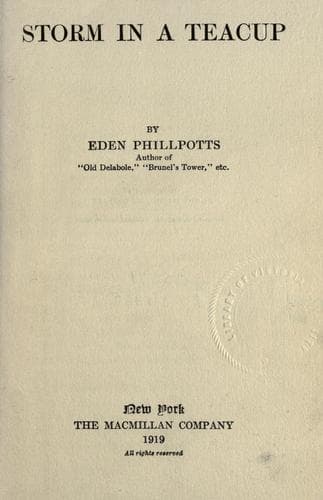
Devon (England) -- Fiction; Husband and wife -- Fiction; Man-woman relationships -- Fiction; Paper mills -- Fiction
“It’s just a passing worry I dare say,” suggested Daisy. “When she
forgets herself, she’ll often laugh and chatter in the old way.”
“Well, she’s fonder of you than most, so you help her to forget herself
as often as you can.”
Daisy promised to do so and the elder thanked her.
When the bell rang, they stopped work, and while some, Lydia among
them, went to their baskets for dinner, most flung off their overalls,
donned hats and jackets and hurried home.
As for Mrs. Trivett, she stopped in the shop, ate her meal, then
produced a newspaper and read while others talked.
The day was fine and warm and many groups took their food together in
the sun round about the Mill.
Outside the vat house were Jordan Kellock and Robert Life, another
vatman, while the new-comer, Philander Knox, ate his dinner beside
them. On a bench at hand, Medora and Ned shared the contents of their
basket, and the talk ran up and down.
Mr. Knox had won permanent employment without difficulty. Indeed he
proved a paper maker of the first rank, and while Mr. Trood deprecated
Knox’s very unusual stroke, he admitted that the result was as good as
possible.
Of this matter they were now speaking.
“Ernest Trood is a great formalist,” said Kellock. “He believes in what
you may call tradition and a sort of stroke that you’d say was the
perfection of the craft. But you can’t make a man to a model. You can
show him another man who works on a good pattern—no more.”
“The stroke comes just like every other stroke, whether it’s cricket,
or billiards, or shooting, I reckon,” said Ned Dingle. “It comes, or
else it don’t come. Take me: I’ve tried a score of times to make
paper; but I can’t do it. I can’t get the stroke. But you might have an
apprentice new to it and find, after a month or two, he’d prove himself
in the way to be a paper maker.”
Mr. Knox, who had already won a friendly greeting from his new
associates, in virtue of an amiable character and humorous disposition,
admitted that the vatman was born, not made.
“And you may very near say as much for the beaterman,” he added. “I
never want to see better pulp than you send down to the vat room, Ned
Dingle.”
“’Tis the life and soul of the paper to have such pulp as yours, Ned,”
confirmed Kellock, and the beater was pleased. Praise always excited
Ned and made him chatter.
“I don’t know what there is to it—just thoroughness no doubt and a
keen eye and no scamping of the tests. I take a lot more tests than
most beaters I reckon,” he said.
They discussed their craft and Ned told how for the purposes of
the new water-mark pictures destined for a forthcoming exhibition,
extraordinary pulp would be necessary.
“Soft as milk it will have to be,” he declared.
“I’ve seen the like,” said Knox. “Stuff you’d think couldn’t hold
together. It’s got to find every tiny crevice of the mould; but such
pulp takes the dyes exceeding well.”
Public-domain text, read in full here on John Shaqi.
Reviews
Reviews
No reviews yet
Be the first to share your thoughts on this work.
Join the Discussion
Join the discussion
Sign in to leave a comment or review.
Sign InorCreate an account