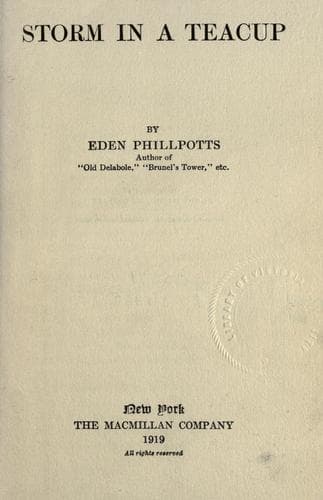
Devon (England) -- Fiction; Husband and wife -- Fiction; Man-woman relationships -- Fiction; Paper mills -- Fiction
“Our dyes are Trenchard’s secret,” answered Dingle. “He’s a great
chemist, as a paper master needs to be. I’d give a lot to look in the
laboratory; but only Trood goes there.”
“A very understanding foreman is Ernest Trood,” admitted Mr. Knox; then
he turned to Medora.
“How’s they fingers?” he asked.
“Better,” she said. “You knock your fingers about rattling them against
the crib.”
“The fingers always suffer,” he admitted. “For my part I shake when
there’s a spell of very hot pulp for the thick papers. I’m feared of my
life the skin will go somewhere and put me out of action for a bit. If
some man could invent a possible glove, many a tender-skinned vatman
would bless him. But a glove would kill the stroke no doubt.”
Dingle pressed more food from their basket on Medora and the well meant
action apparently annoyed her. What passed between them was not heard,
save the last words.
“Don’t be a fool,” she said. “Can’t I have my own way even in that?”
“Hush!” replied Ned. “Have it as you will.”
But she grew angry; her face lowered and she pressed her lips together.
The others joked and Mr. Knox offered Medora a piece of pie.
“Hard hearted devil, you are, Dingle,” he exclaimed. “To eat the cheese
and offer your poor girl the bread.”
Medora jumped up and at the same moment Daisy Finch came along to seek
her. They departed together and strolled from the works up the valley.
But Ned Dingle was evidently disturbed. His face had fallen and he lit
his pipe and went slowly after the women.
“Take my tip and leave her alone,” shouted Knox; then he caught sight
of Kellock’s perturbed countenance and turned to him.
“Aren’t they good friends?” he asked.
“Of course they are—none better.”
“Sometimes a bit of chaff makes a breeze end in laughter,” said the
elder; “and sometimes it don’t.”
“Chaff’s a ticklish thing,” answered Jordan.
“To you it might be, because you’re one of the serious sort, that never
see much to laugh at in anything,” retorted Philander; “but that’s your
loss. Alice Barefoot in the rag house is the same. Can’t see a joke and
mistook my fun yesterday for rudeness. I might have known by her eye
she weren’t a laughter-loving creature. But Mrs. Dingle can laugh.”
“She laughs when there’s anything to laugh at,” said Kellock drily.
“The art is to find something to laugh at in everything,” explained
Philander Knox. “And married people ought to practice that for their
own salvation more than any.”
“How is it you ain’t married?” asked Robert Life. He was a man of few
words and his wife worked in the glazing house with Medora.
“For the very good reason that my wife’s dead,” replied Mr. Knox. She’s
left me for a better place and better company—a very excellent wife
according to her lights, and I missed her.”
“I dare say you’ll find another here,” suggested a man who had come
along a minute before. It was Henry Barefoot, Alice’s brother, the
boilerman—an old sailor, who had drifted into the Mill when his
service days were done.
Public-domain text, read in full here on John Shaqi.
Reviews
Reviews
No reviews yet
Be the first to share your thoughts on this work.
Join the Discussion
Join the discussion
Sign in to leave a comment or review.
Sign InorCreate an account