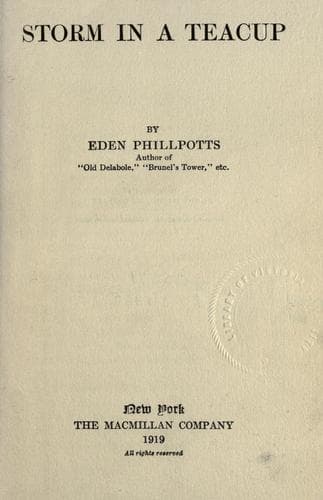
Devon (England) -- Fiction; Husband and wife -- Fiction; Man-woman relationships -- Fiction; Paper mills -- Fiction
“There’s nothing she can’t do,” he answered; “but there’s a damned lot
of things she won’t do. And that’s the trouble to me. Time was when we
saw alike every way and never had a word or a difference of opinion;
but that time’s past seemingly, and I want to know why; and if you
know, I wish you’d tell me. It’s all in a nutshell so far as I can
see. What am I doing to vex her? God’s my judge I don’t know. I’m the
same as I always have been. A chap like me don’t change. I only want
to be patient and cheerful and go on with my life as I’m going. It’s
her that’s changed. She used to love a bit of fun and laughter and be
friendly and easy-going and jolly and kind. That’s what she was when
I married her anyway. But she’s changed and I’m getting fairly fed
up, because I don’t know of any fault in myself to explain it. If I’d
pretended to be different from what I am before we were married and
deceived her in anything, then she’d have a case against me. But nobody
can say I did. She knew just what I was, and I thought I knew just what
she was.”
“You did, Ned,” said Mrs. Trivett earnestly. “You take my word that you
did know just what she was. And what she was, she is still under her
skin. She can’t change really, any more than you can, or anybody else.
She took you because you suited her and she knew she’d be happy with
you. And what’s happening to her just now is a passing thing calling
for patience. Women have their funny moods and whims—Medora like the
rest.”
“I grant that, but how long is it going to last? I know they get queer
in their heads sometimes, but she’s down in the mouth always now. I
can’t pleasure her, do what I may, and the things that always delighted
her a year ago bore her now. Damn it! She looks at me sometimes as if
she was a schoolmistress and I was a wicked boy.”
“It’s like this with her; and it’s the same with lots of people who
have had nothing but a good time all their lives. Instead of knowing
their luck, they take their luck to be just the usual state of things,
and they don’t look round and see the scores of people without their
good fortune: they only fancy that other people are more fortunate
than them. They get so bored with the good that they begin to picture
something better. Everybody wants better bread than is made of wheat
sometimes, and especially them that have never tasted worse. We, that
have had to eat barley bread, know our luck—t’others don’t. The thing
for you is to be patient. You’re all right and you’re going on all
right so far as I can tell. I’ll take your word of that and I very
well understand your difficulties. But you’re a man and you’ve got the
brains.”
“She says not,” he answered. “That’s one of the nice things I’m called
to hear now. She didn’t quarrel with my sense or my nonsense a year
ago. Now she says right out that she wishes I had more intellects.
Not a very nice thing to hear. I might be a stone-breaker, or a
hedge-tacker with no sense at all.”
Public-domain text, read in full here on John Shaqi.
Reviews
Reviews
No reviews yet
Be the first to share your thoughts on this work.
Join the Discussion
Join the discussion
Sign in to leave a comment or review.
Sign InorCreate an account