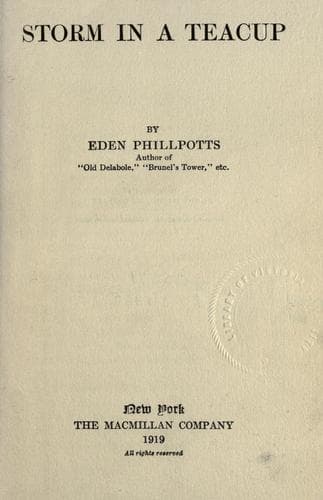
Devon (England) -- Fiction; Husband and wife -- Fiction; Man-woman relationships -- Fiction; Paper mills -- Fiction
“Be patient with her. It’s a whim, and what’s responsible for it I
don’t know more than you. But it will pass. She can’t go on pretending
she’s an unhappy woman—”
“No, and she shan’t,” he said. “I’m only a human man myself, and it’s a
proper outrage for her to make out she’s being bullied and evil treated
by a chap that worshipped the ground under her feet and would again.
She’s mean, mother.”
“No, Ned, she’s foolish; she ain’t mean.”
“She is mean. List to this. Two night ago Kellock came to supper with
us—to help eat that jugged hare—and the talk was serious to death,
as it always is with him—him being such a serious man. And presently,
among a lot of other soaring notions, Medora wondered what was the
height of bliss. And she said the height of bliss was to feel she was
doing good, noble work in the world and helping to make people happier.”
Mrs. Trivett sniffed, but did not respond.
“Well,” continued Ned, “I didn’t say nothing to that, though it sounded
a bit thin to me; but Kellock declared it was a very grand thought, and
for his part the height of bliss was to feel you’d got a move on, and
was leaving a mark and doing solid spade work, that would lift the next
generation to more happiness. And, of course, Medora purred over that.
And then she asked me what my height of bliss was—in a pitying tone of
voice, as though she and Jordan belonged to another world. Well, I said
my height of bliss was lying in my new bath-room of a Saturday night,
with the hot water up to my chin, thinking of my savings in the bank.”
“You didn’t, Ned!”
“I did—just to give ’em a shake up. And just to remind Medora I built
that bath-room on to my house—not because I wanted it, but because she
did. Well, I knew Kellock wouldn’t see the joke, because he ain’t built
to; but, damn it—I did think Medora would. I expected she’d laugh
and lighten up the talk a bit. But not her. She pulled a long face,
and said I ought to be ashamed to confess such ideas. And that was
mean—you can’t deny it.”
“It was,” admitted Medora’s mother. “Her sense of fun’s deserted her;
or else she’s hiding it of a purpose.”
“Another thing,” grumbled Mr. Dingle, “that same night when Kellock
was gone, I got a bit angered with her, God forgive me, and I took her
rough by the arm, and it left a bit of a blue mark on her skin. I very
nearly went on my knees for sorrow after, and she forgave me, and made
it up. Well, you’d think a decent woman would have kept her sleeve down
for a day or two till the mark was gone; but I went to speak to her in
the glazing room yesterday, and there was her forearm bare for all the
women to see, and the chaps at the presses. And when they asked her
how she came by it, as they did, she made a business of not telling
them—which, of course, did tell them. And that was mean, too.”
Mrs. Trivett looked anxious, and put her hand on his arm.
Public-domain text, read in full here on John Shaqi.
Reviews
Reviews
No reviews yet
Be the first to share your thoughts on this work.
Join the Discussion
Join the discussion
Sign in to leave a comment or review.
Sign InorCreate an account