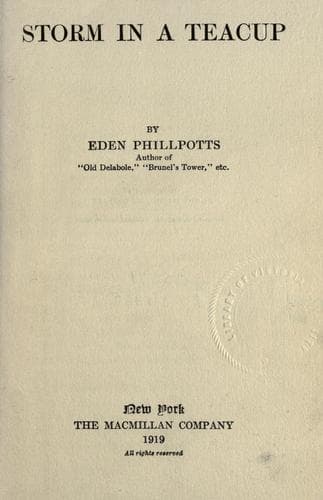
Devon (England) -- Fiction; Husband and wife -- Fiction; Man-woman relationships -- Fiction; Paper mills -- Fiction
“Don’t you knock her about, Ned. I know how aggravating a woman can be;
but don’t you do that. I’m not standing up for her, and I’ll talk to
her again and try to show her what she’s doing; but don’t you give her
a shadow of excuse for this silliness, because, in her present mood,
she’ll be very quick to take advantage of it. I know you very well, and
I was properly glad when Medora took you and not the other, because I
knew her, too, and felt she’d be happier with you in the long run. But
I only say again, be patient until seventy times seven, there’s a good
man, for that’s all you can do about it at present.”
“So I will then,” he promised, “and we’ll leave it at that. And if
you’ll take your chance to talk sense to her, I’ll be a good bit
obliged.”
The rain had ceased, and Lydia went out for a breath of air, while Ned
lighted his pipe and accompanied her. A good few of the workers were
at hand, and Mr. Knox, seeing Mrs. Trivett and her son-in-law, joined
them. Kellock passed, but did not stop, and Philander Knox praised him.
“Now, there’s a chap that’ll go far—either here or somewhere else,”
he said. “Most of you Devon people I’ve yet met with are pretty
easy-going, like myself; but that man is not. He’s more than a paper
maker. Dingle here, and Life, and old Pinhey, the finisher, and Trood
are content to go on their way, and leave other people to do the same.
Kellock is not.”
“He’s got ideas,” said Lydia.
“He has. I’ve took a room in the same house where he lodges, and I’ve
heard him air his notions. They’re commonplace talk where I come from,
but a bit ahead of the times in the West Country. We middle-aged folk
ain’t interested in ’em, but the rising generation is. He told me
straight out that we ought to have shop stewards in the Mill.”
“Not at all,” said Dingle. “We don’t want nothing of that here.”
“A burning mind for the rights of labour,” continued Knox, “and though
you may think we don’t want shop stewards, and I may think so, and the
boss may think so, shop stewards are a sign of the times, and they’ll
come everywhere before long.”
“I hope not,” said Lydia.
“And shop stewardesses,” added Philander; “and if that happened, you’d
have to rise to it, Mrs. Trivett, for the good of the young women.”
Lydia laughed.
“They might be wanted in some places—not here,” she said. “We all
work very comfortably and steady, and there’s none discontented in my
department, that I know about.”
“Just because you’re the head of it and are a very clever and human
sort of woman,” answered Mr. Knox. “You’ve got the touch, and you
understand the nature of the female and how to keep her in a good
temper, and how to get a fair day’s work for a good day’s wages.”
Ned left them at this juncture, and Mr. Knox proceeded. Much to her
surprise he praised Mrs. Trivett in good set terms.
Public-domain text, read in full here on John Shaqi.
Reviews
Reviews
No reviews yet
Be the first to share your thoughts on this work.
Join the Discussion
Join the discussion
Sign in to leave a comment or review.
Sign InorCreate an account