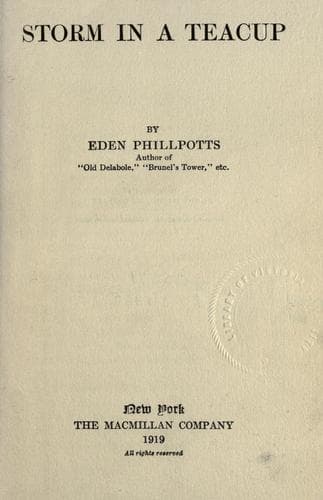
Devon (England) -- Fiction; Husband and wife -- Fiction; Man-woman relationships -- Fiction; Paper mills -- Fiction
“You can have too much reality,” declared Philander. “Most of us poor
people have such a deuce of a lot of reality that we get tired of it.
There’s thousands for that matter that never have anything else; and
reality ain’t fattening if you belong to the labouring classes. But if
she’d took Jordan Kellock, then she’d have known what reality was, and
very likely gone down under it, like a mole under a cart wheel. He’s a
wonderful good, earnest man—worth all the rest of us put together,
I dare say; but as a husband for a young, pretty, laughter-loving
woman—no. He ain’t built that way, and if your Medora finds that
Dingle isn’t all she dreamed—as what man is after the gilt’s off the
gingerbread?—then let her be sure she’d have done still worse along
with Kellock.”
Mrs. Trivett was moved, and nodded vigorously. “Very good sense, and
you echo me,” she answered. “I’ve thought much the same. You’re an
understanding man, and kind-hearted seemingly, and have been married
yourself, so you see things in a large spirit. I think my girl took the
right one.”
“Then she did, for you’d make no mistake,” declared Knox. “And if the
right one, then we can trust time to prove it. I’m a great believer in
the marriage state myself. It’s a power for good most times, and so I
hope you found it.”
But Mrs. Trivett was not prepared for any further confidences on this
occasion. She did not answer his question, though she expressed herself
a believer in marriage.
CHAPTER VIII
ASSAULT AND BATTERY
In the engine house a small, hump-backed man sat picking over the
masses of wet rag brought to him by Henry Barefoot from the boilers.
For, despite the sorters and the magnet, enemies to paper still lurked
in the sodden rag, and the little man ran the sloppy stuff through his
fingers, extracting from time to time fragments of rubber, whalebone,
pearl, and other substances.
The engine house was a lofty chamber on two floors, with windows that
faced the west. Here, Ned Dingle reigned, and half a dozen men worked
under him. Much happened to the rag before it came to Ned, for after
its final picking, it was washed again, and broken before the beater
turned it into pulp. When the little hump-backed man had passed it,
the rag was set revolving with water in oval, lead-lined breakers.
On one side the washer, like a steamer’s paddle-wheel, churned in a
bladed barrel, so that the rag was not only cleaned again, but also
torn to the smallest fragments; on the other side a drum of brass wire
sucked away the dirty water, while from the upper end clean water was
perpetually spurting in. Round and round the rag revolved for three
hours, by which time its character had changed entirely. It was, in
fact, rag no more, but a substance like curds: “half stuff,” or rag
transformed and half-way to its final stages.
Public-domain text, read in full here on John Shaqi.
Reviews
Reviews
No reviews yet
Be the first to share your thoughts on this work.
Join the Discussion
Join the discussion
Sign in to leave a comment or review.
Sign InorCreate an account