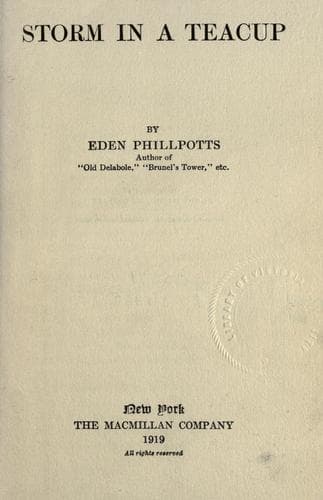
Devon (England) -- Fiction; Husband and wife -- Fiction; Man-woman relationships -- Fiction; Paper mills -- Fiction
From the breakers the pulpy mass left the engine house for a time,
and sojourned in the bleaching tanks beneath. It flowed down through
pipes to a subterranean chamber, where the air was sharp with the
smell of chemicals, and twelve great, gaping wells ranged round a
narrow passage way. Here came the “half stuff” to repose on beds of
Delabole slate, and endure the operations of the bleach for half a day
or more. Then the liquid was drained off, the snow-white, solid masses
forked out on to little trolleys, and so returned to Ned Dingle in the
engine house. Again it revolved until the bleach was thoroughly washed
out of it, for it is a principle of great paper making that the less
chemicals, the better the pulp; and now perfected, washed, broken and
bleached, the material came to the beater for final dissection.
The beaters’ engines were oval in form and resembled the breakers. They
stood upon the lower floor of the engine house, and each communicated
directly with the breaker above it, and the vat room far beneath. From
final washing, the pulp flowed directly to Mr. Dingle, and, as before,
revolved, and was churned by a paddle-wheel set with fine knives. Ned
controlled it, and on his judgment depended the quality of the pulp
that would presently flow down to Kellock, Knox, and the other vatmen.
He was explaining the process to a young man, who had just been
promoted to his assistant from the breakers above.
“It’s got to meet every test that experience can bring against it,
Jacob,” he said. “And if it did not, I should mighty soon hear of it.”
He regulated the churning wheel with a footplate, and presently,
satisfied that the mass, which was now like fine cream after revolving
in the beating tank for many hours, had reached perfection, Ned took a
test to satisfy himself.
Two hand-bowls, or dippers, he lifted, scooped up a few ounces of the
pulp, then mixed it with pure water, and flung the liquid backwards
from one dipper to the other, pouring off and adding fresh water until
what was left in his bowl resembled water barely stained with soap. The
pulp was now so diluted that it needed sharp eyes to see anything in
the water at all; but Dingle, taking it to the window, set it slowly
dribbling away over the edge of the bowl, and as it flowed, the liquid
revealed tiny fragments and filaments all separate, and as fine as
spider’s thread. The spectacle of these attenuated fibres of cotton
told the beaterman that his engine was ready and the pulp sufficiently
fine. The masses of rag, once linen and lace, and every sort of textile
fabric woven of cotton, had become reduced to its limit of tenuity, and
was now far finer stuff than in the cotton pod of its creation. It had
been beaten into countless millions of fibrils, long and short, and all
so fine as to need sharpest scrutiny of human eye to distinguish them.
Public-domain text, read in full here on John Shaqi.
Reviews
Reviews
No reviews yet
Be the first to share your thoughts on this work.
Join the Discussion
Join the discussion
Sign in to leave a comment or review.
Sign InorCreate an account