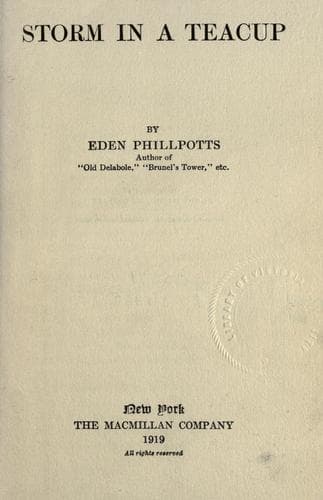
Devon (England) -- Fiction; Husband and wife -- Fiction; Man-woman relationships -- Fiction; Paper mills -- Fiction
Philander had designed to enliven the tea with humorous chatter. He
wished to impress Mr. Dolbear and his wife favourably, for he was a
sociable person and anxious to increase the number of friends in his
new home; but he found a meal at Priory Farm no occasion for much
intercourse or advancement of amenities. It proved a strenuous and
rather exasperating affair. The children dominated the tea and the tea
table. They chattered until they had eaten all they could and departed;
then, when the visitor hoped that his opportunity had come, he found,
instead, that their mother took up the conversation and discussed the
vanished youngsters one by one. She lingered over each as a gardener
over his treasures, or a connoisseur over his collection. They were an
incomparable group of children, it appeared; and what puzzled Philander
was to find that Lydia enjoyed the subject as much as Mary herself. She
also knew the children by heart and was evidently devoted to each and
all of them.
Tom Dolbear said very little, but enjoyed listening. His brood rejoiced
him and he lived now in hope of another boy.
It was Medora who strove to change the subject and allow Bobby and
Milly and Clara and Jenny and the rest to drop out of the conversation.
“Mr. Knox will be sick to death of your babies, Aunt Polly,” she said.
“Far from it,” he declared. “A finer, hopefuller family I never wish to
see.”
Mr. Dolbear then invited Philander to come into the garden and smoke,
but finding the ladies were not prepared to accompany them, he declined.
“If it’s all the same to you, I’ll rest here until I must get going,”
he answered. “I’m not used to your hills yet and they weary my legs a
lot. Never a great walker—after the way of town birds that have lived
all their lives by a tram line.”
So he sat and smoked, while Lydia cleared the tea things and Medora
helped her.
With Mrs. Trivett there were few opportunities for speech. She came
and went and worked. Then the dusk fell and the younger Dolbears were
brought in to go to bed. Medora nursed the baby for a time and her
mother noticed that she was more than usually cheerful.
Knox then declared that he must be going home and offered to escort
Medora. She agreed and having thanked Tom for his hospitality and hoped
that he might be privileged to accept it again at some future time, he
took his leave. On the way home he spoke to his companion.
“Your mother’s a wonderful woman, Mrs. Dingle,” he said. “I see these
things from the outside and I’m properly astonished at her cleverness.”
“So she is,” admitted Medora. “But I wish she wouldn’t work so hard all
the same. She does her day at the Mill and then comes back home and
instead of getting her proper rest—well, you see what it is.”
“She’s like the mainspring of a watch,” declared Philander. “’Tis a
most delicate contrivance, yet all depends upon it; and if I may say
so, as an outsider, you can see with half an eye that her relations
depend upon her for everything.”
Public-domain text, read in full here on John Shaqi.
Reviews
Reviews
No reviews yet
Be the first to share your thoughts on this work.
Join the Discussion
Join the discussion
Sign in to leave a comment or review.
Sign InorCreate an account