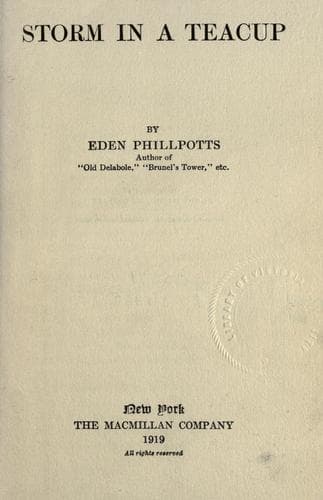
Devon (England) -- Fiction; Husband and wife -- Fiction; Man-woman relationships -- Fiction; Paper mills -- Fiction
“They do—they do. If anything happened to mother, I don’t know what
would become of Aunt and Uncle—let alone all the children.”
“They don’t know their luck,” he said, and Medora agreed with him.
“I’m glad you see it. I’ve often thought that—so have other people. My
mother at Priory Farm is like a cheese-cake in a pigstye.”
“Strong, but not too strong. She must have great affection for them to
stand it.”
“Once a man offered for mother,” said Medora; “and, at the first
whisper of it, Uncle Tom and Aunt Polly pretty well went on their knees
to her not to leave them.”
“I can well believe it. It didn’t come to anything, however?”
“No, no—mother’s not for another husband.”
“If anything might make her think upon such a change, it would be that
household surely.”
“No,” answered Medora. “It’s just that helpless household that would
make her sacrifice herself. Duty’s her God. She’s mother to all those
children—more their mother than Aunt Polly in a way—for my aunt is so
busy bringing them into the world, that she’s got to leave all the rest
of the work to other people.”
Mr. Knox shook his head.
“It’s contrary to nature that such a fine woman as Mrs. Trivett should
hide her light under that bushel,” he asserted. “It’s a very selfish
thing to let her slave and wear her fingers to the bone like that; but
it often happens so. A husband and wife with a long family always seem
to fasten on some good-natured, kindly creature and drag her in their
house to be a slave to their children. There’s no selfishness like the
selfishness of a pair with a long quiver. They’ll fairly batter the
life out of anybody who’s fool enough to lend a hand; and the more such
a person does for the other woman’s children, the more she may do. But
I should hope your mother was too proud to let herself be used as a
nursemaid to her own nieces.”
“She’s never proud where children are concerned,” answered Medora.
“She’ll stop there till she’s worn out.”
“A very gloomy picture and I hope you’re wrong, Mrs. Dingle,” he
answered.
CHAPTER X
THE LETTER
In the vat house there took place the transformation from liquid to
solid, from pulp to paper, from a gruel-like, tenuous compound to a
substance strong enough to stand strain of many pounds and last for
centuries.
Here was the largest building in the Mill—a very lofty, brightly
lighted, airy hall, from whose open roof descended electric lights
hanging above each vat. A steady whirr and throb of noisy engines made
a din here, but the vatmen and their couchers were used to it and could
hear themselves speak through the familiar riot.
Public-domain text, read in full here on John Shaqi.
Reviews
Reviews
No reviews yet
Be the first to share your thoughts on this work.
Join the Discussion
Join the discussion
Sign in to leave a comment or review.
Sign InorCreate an account