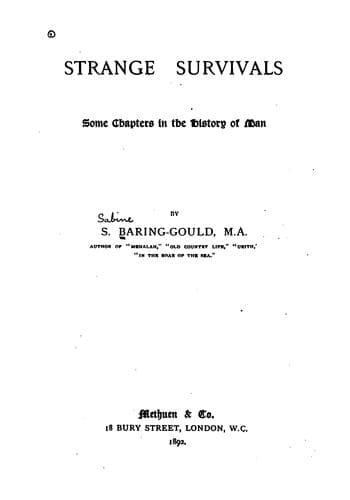
Strange Survivals: Some Chapters in the History of ManBaring-Gould, S. (Sabine)
History
Strange Survivals: Some Chapters in the History of Man
Baring-Gould, S. (Sabine)
Manners and customs -- Origin; Superstition
Here we have the historic geste and the light and ribald tale. When
Chaucer recited the Ballad of Sir Thopas, conceived after the fashion
of the old romances, the host interrupted him and said--
“This may well be rime--dogerel,
Mine eres aken of thy drafty speche.”
We heartily wish that Chaucer had finished the tale. The host merely
repeated the general objection to the heroic ballad, and showed the
common preference for the ribald tales. The author of the “Vision of
Piers the Ploughman,” complains that the passion for songs and ballads
was so strong that men attended to these to the neglect of more serious
and of sacred matters.
“I cannot parfitly my paternoster, as the priest it singeth,
But I can ryme of Roben Hode, of Randolf erl of Chester,
But of our Lord and our Lady I learn nothing at all;
I am occupied every day, holy daye and other, with idle tales at the
ale.”
The degradation in the meaning of the names once given to minstrels of
various classes tells its own sad tale. The _ryband_ has lent his name
to ribaldry; the _scurra_ to whatever is scurrilous; the _gestour_, who
sang the _gestes_ of heroes, became the jester, the mere buffoon; the
_joculator_ degenerated into a joker; and the _jongleur_ into a juggler.
A few men of taste and of reverence for the past stood up for the old
heroic ballads, which, indeed, contained the history of the past, mixed
with much mythical matter. So the great Charles, says his scribe,
Eginhard, “commanded that the barbarous and most ancient song in which
the acts and wars of the old kings were sung should be written down and
committed to memory.” And our own Alfred, says Asser, “did not fail
to recite himself and urge on others, the recitation by heart of the
Saxon songs.” But the English ballad found no favour with the Norman
conquerors, who readily received the Provençal troubadour. The old
heroic ballad lingered on, and was killed, not so much by the ridicule
of Chaucer as by the impatience of the English character, which will
not endure the long-drawn tale, and asks in preference what is pithy
and pointed.
Of song and ballad there were many kinds, characterised rather by the
instrument to which it was sung, than by the nature of the song itself;
or perhaps we may say most justly that certain topics and certain
kinds of composition suited certain instruments, and were, therefore,
accommodated to them.
In the “Romans de Brut” we have a list of some of these:
“Molt ot a la cort jugleors,
Chanteors, estrumanteors;
Molt poissiez oir chançons,
Rotruanges et noviaz sons
Vieleures, lais, et notes,
Lais de vieles, lais de rotes,
Lais de harpe et de fretiax.”
Public-domain text, read in full here on John Shaqi.
Reviews
Reviews
No reviews yet
Be the first to share your thoughts on this work.
Elsewhere in the archive
Join the Discussion
Join the discussion
Sign in to leave a comment or review.
Sign InorCreate an account