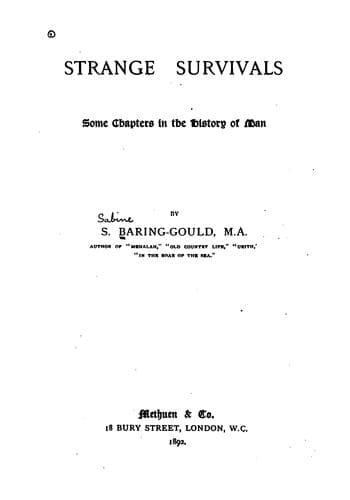
Strange Survivals: Some Chapters in the History of ManBaring-Gould, S. (Sabine)
History
Strange Survivals: Some Chapters in the History of Man
Baring-Gould, S. (Sabine)
Manners and customs -- Origin; Superstition
The latest instance of a human being having been immured alive, of
which a record remains and which is well authenticated, is that of
Geronimo of Oran, in the wall of the fort near the gate Bab-el-oved,
of Algiers, in 1569. The fort is composed of blocks of _pise_, a
concrete made of stones, lime, and sand, mixed in certain proportions,
trodden down and rammed hard into a mould, and exposed to dry in the
sun. When thoroughly baked and solid it is turned out of the mould, and
is then ready for use. Geronimo was a Christian, who had served in a
Spanish regiment; he was taken by pirates and made over to the Dey of
Algiers. When the fort was in construction, Geronimo was put into one
of the moulds, and the concrete rammed round him (18th Sept., 1569),
and then the block was put into the walls. Don Diego de Haedo, the
contemporary author of the “Topography of Algiers,” says, “On examining
with attention the blocks of pise which form the walls of the fort, a
block will be observed in the north wall of which the surface has sunk
in, and looks as if it had been disturbed; for the body in decaying
left a hollow in the block, which has caused the sinkage.”
On December 27, 1853, the block was extracted. The old fort was
demolished to make room for the modern “Fort des vingt-quatre-heures,”
under the direction of Captain Susoni, when a petard which had been
placed beneath two or three courses of pise near the ground, exploded,
and exposed a cavity containing a human skeleton, the whole of which
was visible, from the neck to the knees, in a perfect state of
preservation. The remains, the cast of the head, and the broken block
of pise, are now in the Cathedral of Algiers.
The walls of Scutari are said also to contain the body of a victim; in
this case of a woman, who was built in, but an opening was left through
which her infant might be passed in to be suckled by her as long as
life remained in the poor creature, after which the hole was closed.
At Arta also, in the vilajet of Janina, a woman was walled into
the foundation of the bridge. The gravelly soil gave way, and it
was decided that the only means by which the substructure could be
solidified was by a human life. One of the mason’s wives brought her
husband a bowl with his dinner, when he dropped his ring into the hole
dug for the pier, and asked her to search for it. When she descended
into the pit, the masons threw in lime and stones upon her, and buried
her.
Public-domain text, read in full here on John Shaqi.
Reviews
Reviews
No reviews yet
Be the first to share your thoughts on this work.
Join the Discussion
Join the discussion
Sign in to leave a comment or review.
Sign InorCreate an account