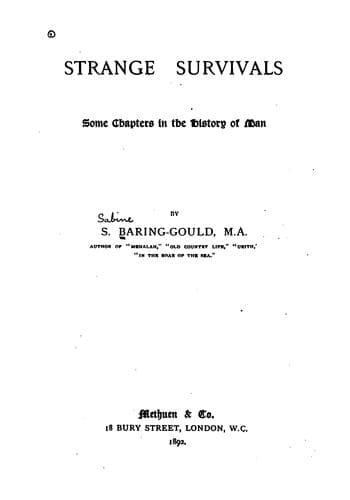
Strange Survivals: Some Chapters in the History of Man — John Shaqi
Strange Survivals: Some Chapters in the History of ManBaring-Gould, S. (Sabine)
History
Strange Survivals: Some Chapters in the History of Man
Baring-Gould, S. (Sabine)
Manners and customs -- Origin; Superstition
The following story is told of several churches in Europe. The masons
could not get the walls to stand, and they resolved among themselves
to bury under them the first woman or child that came to their works.
They took oath to this effect. The first to arrive was the wife of
the master-mason, who came with the dinner. The men at once fell on
her and walled her into the foundations. One version of the story is
less gruesome. The masons had provided meat for their work, and the
wife of the master had dealt so carelessly with the provision, that
it ran out before the building was much advanced. She accordingly put
the remaining bones into a cauldron, and made a soup of vegetables.
When she brought it to the mason, he flew into a rage, and built
the cauldron and bones into the wall, as a perpetual caution to
improvident wives. This is the story told of the church of Notre Dame
at Bruges, where the cauldron and bones are supposed to be still seen
in the wall. At Tuckebrande are two basins built into the wall, and
various legends not agreeing with one another are told to account for
their presence. Perhaps these cauldrons contained the blood of victims
of some sort immured to secure the stability of the edifice.[3]
A very curious usage prevails in Roumania and Transylvania to the
present day, which is a reminiscence of the old interment in the
foundations of a house. When masons are engaged on the erection of a
new dwelling, they endeavour to catch the shadow of a stranger passing
by and wall it in, and throw in stones and mortar whilst his shadow
rests on the walls. If no one goes by to cast his shade on the stones,
the masons go in quest of a woman or child, who does not belong to the
place, and, unperceived by the person, apply a reed to the shadow,
and this reed is then immured; and it is believed that when this is
done, the woman or child thus measured will languish and die, but
luck attaches to the house. In this we see the survival of the old
confusion between soul and shade. The Manes are the shadows of the
dead. In some places it is said that a man who has sold his soul to the
devil is shadowless, because soul and shadow are one. But there are
other instances of substitution hardly less curious. In Holland have
been found immured in foundations curious objects like ninepins, but
which are really rude imitations of babes in their swaddling-bands.
When it became unlawful to bury a child, an image representing it was
laid in the wall in its place. Another usage was to immure an egg. The
egg had in it life, but undeveloped life, so that by walling it in
the principle of sacrificing a life was maintained without any shock
to human feelings. Another form of substitution was that of a candle.
From an early period the candle was burnt in place of the sacrifice
of a human victim. At Heliopolis, till the reign of Amasis, three men
were daily sacrificed; but when Amasis expelled the Hyksos kings, he
Public-domain text, read in full here on John Shaqi.
Reviews
Reviews
No reviews yet
Be the first to share your thoughts on this work.
Join the Discussion
Join the discussion
Sign in to leave a comment or review.
Sign InorCreate an account