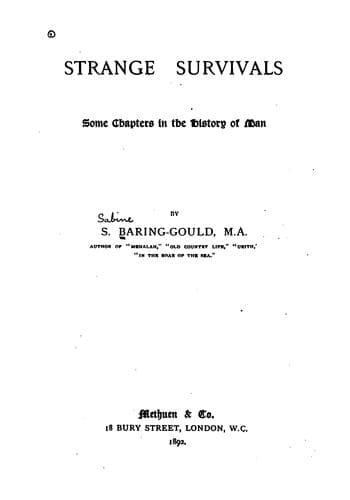
Strange Survivals: Some Chapters in the History of Man — John Shaqi
Strange Survivals: Some Chapters in the History of ManBaring-Gould, S. (Sabine)
History
Strange Survivals: Some Chapters in the History of Man
Baring-Gould, S. (Sabine)
Manners and customs -- Origin; Superstition
It is noticeable in Cornwall and on Dartmoor that the clusters of hut
circles are generally associated on the one hand with tin stream works,
and on the other with avenues and circles of upright stones, and that
the heights of the hills near them are topped with cairns that contain
kistvaens, or graves of rude stones, set on end and capped with large
granite coverers. It may be taken as almost certain that where there is
a large cluster of these dwellings, there will be found some megalithic
monument hard by, or if not, that the enclosures, or the moor, will
bear some name, such as Ninestones, or The Twelve Men (Maen = a stone),
that testifies to there having been a circle there, which has been
destroyed. With tin works the circles of hut foundations are invariably
associated. In Holyhead, where is the cluster of bee-hive huts examined
by Mr. Stanley, there also are to be found the Meinihirion, long
stones, two stones standing ten feet apart, rising eleven feet above
the soil, and originally surrounded by a circle of upright stones, now
removed to serve as gate posts, or to form fences. There is sufficient
evidence to show that the first builders of the bee-hive huts were
the men of that race which erected the rude stone monuments in our
island, and who also worked the tin. But what race was that? It was not
Keltic. It was in our island before the Britons arrived. We can trace
its course of migration from the steppes of Asia by the monuments it
erected. This mysterious people came to the Baltic and followed its
shores, some crossed into what was afterwards Scandinavia, but the
main tide rolled along the sea-shore. They have left their huge stone
monuments in Pomerania, in Hanover. They crossed the Rhine, and from
Calais saw the white cliffs of Albion and one large branch of the
stream invaded and colonised the British Isles. Another, still hugging
the sea, passed along the coast of Gaul to Brittany, thence descended
the shores of the Bay of Biscay, sent settlers up the Seine, the
Loire, and the Dordogne, swept on into the Iberian peninsula, crossed
into Africa, and after setting up circles and dolmens in Algeria,
disappeared. They never penetrated to the centre of Germany; the Oder,
and the Elbe, and the Rhine offered them no attractions. They were a
people of rocks and stones, and they were not attracted by the vast
plains of Lower Germany; they never saw, never set up a stone in the
highlands, in the Black Forest, or the Alps. But it was otherwise with
the great rivers of Gaul; with the sole exception of the Rhone they
followed them up. Their monuments are numerous on the Loire; they are
as dense in the upper waters of the Lot and Tarn as they are among
the islets and on the headlands of Brittany. It is doubtful if they
ever set foot in Italy. Such was the course taken by the great people
which migrated to Europe. But another branch had separated at the
Caspian, and had turned South. It passed over the Tigris and Euphrates,
Public-domain text, read in full here on John Shaqi.
Reviews
Reviews
No reviews yet
Be the first to share your thoughts on this work.
Join the Discussion
Join the discussion
Sign in to leave a comment or review.
Sign InorCreate an account