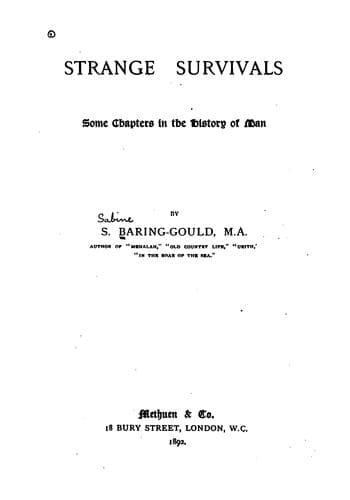
Strange Survivals: Some Chapters in the History of ManBaring-Gould, S. (Sabine)
History
Strange Survivals: Some Chapters in the History of Man
Baring-Gould, S. (Sabine)
Manners and customs -- Origin; Superstition
The charges which had been brought by heathens against early Christians
were now, under altered circumstances, launched by Christians against
heretics and witches. The hideous description of Christianity given
by Cœcilius, in Minutius Felix, as a secret and desperate faction
leagued against God and man, and celebrating the foulest nocturnal
rites, became the type of accusations levelled by orthodox Christians
against their dissenting brethren; and, as the charge of Cœcilius was
justified by the conduct of a portion of the Christian converts, so was
the charge of the orthodox against the schismatics in mediæval times
justified by the conduct of some of them. The Cathari, Manichæans,
Paulicians, Patarines, Albigenses, were all heretics so far that they
reverted to heathenism, and to its most simple form of Schamanism, and
some of the congregations sank into the grossest immorality.
The writers on witchcraft who theoretically worked out its criminal
details--Eumericus, Nider, Bernhard of Como, and Jacquier--spoke of
it as “Secta et hæresis maleficorum,” it was a heresy, one of the
several forms in which lapse from the faith took. Balduinus identified
Waldenses with witches.
In 1484, James Sprenger and Henry Justitor, appointed inquisitors for
Upper Germany, obtained the celebrated bull of Innocent VIII., which,
though far from being the origin of witch prosecutions, acted with
signal effect in promoting their subsequent activity. Sprenger followed
it up with his well-known treatise called “Malleus Maleficarum,” as a
guide to judicial theory and practice.
No object is gained by dwelling on the details of an epidemic which,
for three centuries, devastated Europe, destroying so many lives.
Yet two particulars challenge inquiry and remark: one, the strange
uniformity of the offence as elicited by confession; the other, the
curious analogy which is found to exist between the rites practised by
the witches at their gatherings and those of the heretics of earlier
times, Pagan and semi-Christian. The uniformity in the confession of
the witches has excited surprise, and has been variously accounted
for--some supposing that there must have been an external reality
in the way of profane imposture, a remnant of heathen practice;
others referring it to morbid subjectivity in the accused, caused by
melancholy and hypochondria.
That there was some objective reality, I can hardly doubt; not only are
the confessions of those accused curiously alike in their account of
the ceremonies of the Sabbath, when they assembled, but we know that
human nature is always the same, and it is inconceivable that there
should have been a cessation at any period of those gatherings of men
and women who found the only satisfaction for their religious cravings
in vague spiritualism.
Public-domain text, read in full here on John Shaqi.
Reviews
Reviews
No reviews yet
Be the first to share your thoughts on this work.
Elsewhere in the archive
Join the Discussion
Join the discussion
Sign in to leave a comment or review.
Sign InorCreate an account