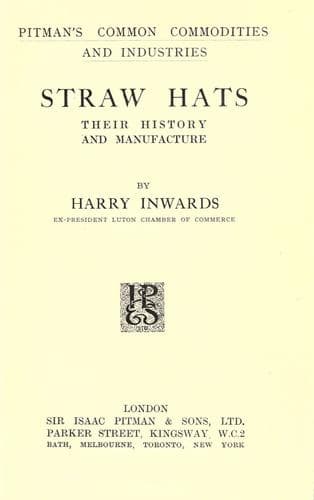
Straw Hats: Their history and manufactureInwards, Harry
History
Straw Hats: Their history and manufacture
Inwards, Harry
Hats; Straw industries
The dyeing of straw plait in England, done individually for some time
on a small scale, commenced as a separate industry about 1845, when a
Mr. Randall opened some dyeing works at Sundon, a village about four
miles from Luton. Black, and a very poor brown and dark blue, were the
only colours then dyed. Shortly after Mr. Thomas Lye, who came from
Kirkby Malzeard, near Ripon, Yorks, which was a plait making centre,
started business as a dyer in Luton. His gamut of shades numbered only
four or five, and the standard of colour then demanded was very low.
Mr. Lye’s first signal success was a “grey,” which at that time no
other competitor had attempted. In 1857 his business was transferred
to its present site. Other colours quickly followed, and the invention
of aniline dyes revolutionized the old “vegetable dye” processes, of
which the ingredients were madder, indigo, logwood and fustic. These
wood dyes required a long and costly process, and involved the use of
mordants to prepare the straw for the different colours, and their
somewhat cumbersome methods rendered them at all times rather uncertain
in their results. With the advent of the more easily handled synthetic
dyestuffs the operations of wood dyeing became less frequent, and
although to-day black is still produced from logwood chips, practically
all colours are dyed with one or the other extracts of coal tar, etc.
The main considerations of dyeing are brilliance of shade with perfect
evenness of colour, and penetration of the dye right through the straw.
Unlike some textile fabrics, fastness either to light or even to water
is not insisted on; but absolute penetration is a necessity, for should
any part of the straw when plaitted become abraded, if the colour were
only on the surface, the worn part would show a lighter tint; and also
if when the “button” or centre of the hat was made, the turning of
which being in such tiny circles, the straws are disturbed to their
utmost, and the light coloured spaces which would result would impair
the regularity of colour. And the dyeing penetration of straws or straw
plait, composed as it is of such diversity of elements, the hard flint
like exterior and the soft pappy inside, is a matter of considerable
difficulty, even if dyers had not to contend, first, with the extreme
hardness of water which is common in the South Bedfordshire district,
and second, the constant cleansing necessary on changes in fashionable
colours necessitating the use of coppers, the chemical effects of which
in some instances need counter action to achieve a good result.
Public-domain text, read in full here on John Shaqi.
Reviews
Reviews
No reviews yet
Be the first to share your thoughts on this work.
Join the Discussion
Join the discussion
Sign in to leave a comment or review.
Sign InorCreate an account