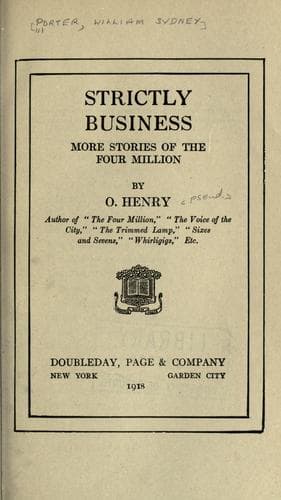
Strictly Business: More Stories of the Four MillionHenry, O.
Philosophy
Strictly Business: More Stories of the Four Million
Henry, O.
New York (N.Y.) -- Social life and customs -- Fiction
Forster lost.
Ives laughed and began to name liquids and viands to the waiter with
the absorbed but calm deliberation of one who was to the menu born.
Forster, listening, gave his admiring approval of the order.
“I am a man,” said Ives, during the oysters, “Who has made a lifetime
search after the to-be-continued-in-our-next. I am not like the
ordinary adventurer who strikes for a coveted prize. Nor yet am I like
a gambler who knows he is either to win or lose a certain set stake.
What I want is to encounter an adventure to which I can predict no
conclusion. It is the breath of existence to me to dare Fate in its
blindest manifestations. The world has come to run so much by rote and
gravitation that you can enter upon hardly any footpath of chance in
which you do not find signboards informing you of what you may expect
at its end. I am like the clerk in the Circumlocution Office who always
complained bitterly when any one came in to ask information. ‘He wanted
to _know_, you know!’ was the kick he made to his fellow-clerks. Well,
I don’t want to know, I don’t want to reason, I don’t want to guess—I
want to bet my hand without seeing it.”
“I understand,” said Forster delightedly. “I’ve often wanted the way I
feel put into words. You’ve done it. I want to take chances on what’s
coming. Suppose we have a bottle of Moselle with the next course.”
“Agreed,” said Ives. “I’m glad you catch my idea. It will increase the
animosity of the house toward the loser. If it does not weary you, we
will pursue the theme. Only a few times have I met a true venturer—one
who does not ask a schedule and map from Fate when he begins a journey.
But, as the world becomes more civilized and wiser, the more difficult
it is to come upon an adventure the end of which you cannot foresee. In
the Elizabethan days you could assault the watch, wring knockers from
doors and have a jolly set-to with the blades in any convenient angle
of a wall and ‘get away with it.’ Nowadays, if you speak
disrespectfully to a policeman, all that is left to the most romantic
fancy is to conjecture in what particular police station he will land
you.”
“I know—I know,” said Forster, nodding approval.
“I returned to New York to-day,” continued Ives, “from a three years’
ramble around the globe. Things are not much better abroad than they
are at home. The whole world seems to be overrun by conclusions. The
only thing that interests me greatly is a premise. I’ve tried shooting
big game in Africa. I know what an express rifle will do at so many
yards; and when an elephant or a rhinoceros falls to the bullet, I
enjoy it about as much as I did when I was kept in after school to do a
sum in long division on the blackboard.”
“I know—I know,” said Forster.
“There might be something in aeroplanes,” went on Ives, reflectively.
“I’ve tried ballooning; but it seems to be merely a cut-and-dried
affair of wind and ballast.”
“Women,” suggested Forster, with a smile.
Public-domain text, read in full here on John Shaqi.
Reviews
Reviews
No reviews yet
Be the first to share your thoughts on this work.
Elsewhere in the archive
Join the Discussion
Join the discussion
Sign in to leave a comment or review.
Sign InorCreate an account