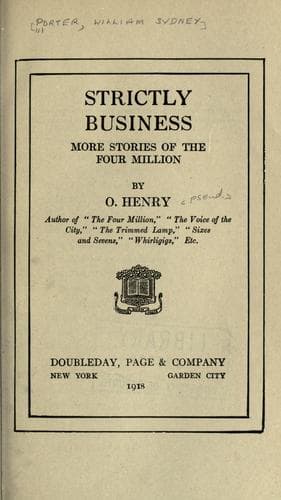
Strictly Business: More Stories of the Four MillionHenry, O.
Philosophy
Strictly Business: More Stories of the Four Million
Henry, O.
New York (N.Y.) -- Social life and customs -- Fiction
But you know the rest. And so did Bob Hart; but he saw somebody else.
He thought he saw that Cherry was the only professional on the short
order stage that he had seen who seemed exactly to fit the part of
“Helen Grimes” in the sketch he had written and kept tucked away in the
tray of his trunk. Of course Bob Hart, as well as every other normal
actor, grocer, newspaper man, professor, curb broker, and farmer, has a
play tucked away somewhere. They tuck ’em in trays of trunks, trunks of
trees, desks, haymows, pigeonholes, inside pockets, safe-deposit
vaults, handboxes, and coal cellars, waiting for Mr. Frohman to call.
They belong among the fifty-seven different kinds.
But Bob Hart’s sketch was not destined to end in a pickle jar. He
called it “Mice Will Play.” He had kept it quiet and hidden away ever
since he wrote it, waiting to find a partner who fitted his conception
of “Helen Grimes.” And here was “Helen” herself, with all the innocent
abandon, the youth, the sprightliness, and the flawless stage art that
his critical taste demanded.
After the act was over Hart found the manager in the box office, and
got Cherry’s address. At five the next afternoon he called at the musty
old house in the West Forties and sent up his professional card.
By daylight, in a secular shirtwaist and plain _voile_ skirt, with her
hair curbed and her Sister of Charity eyes, Winona Cherry might have
been playing the part of Prudence Wise, the deacon’s daughter, in the
great (unwritten) New England drama not yet entitled anything.
“I know your act, Mr. Hart,” she said after she had looked over his
card carefully. “What did you wish to see me about?”
“I saw you work last night,” said Hart. “I’ve written a sketch that
I’ve been saving up. It’s for two; and I think you can do the other
part. I thought I’d see you about it.”
“Come in the parlor,” said Miss Cherry. “I’ve been wishing for
something of the sort. I think I’d like to act instead of doing turns.”
Bob Hart drew his cherished “Mice Will Play” from his pocket, and read
it to her.
“Read it again, please,” said Miss Cherry.
And then she pointed out to him clearly how it could be improved by
introducing a messenger instead of a telephone call, and cutting the
dialogue just before the climax while they were struggling with the
pistol, and by completely changing the lines and business of Helen
Grimes at the point where her jealousy overcomes her. Hart yielded to
all her strictures without argument. She had at once put her finger on
the sketch’s weaker points. That was her woman’s intuition that he had
lacked. At the end of their talk Hart was willing to stake the
judgment, experience, and savings of his four years of vaudeville that
“Mice Will Play” would blossom into a perennial flower in the garden of
the circuits. Miss Cherry was slower to decide. After many puckerings
of her smooth young brow and tappings on her small, white teeth with
the end of a lead pencil she gave out her dictum.
Public-domain text, read in full here on John Shaqi.
Reviews
Reviews
No reviews yet
Be the first to share your thoughts on this work.
Join the Discussion
Join the discussion
Sign in to leave a comment or review.
Sign InorCreate an account