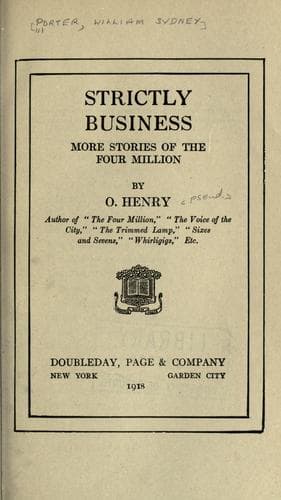
Strictly Business: More Stories of the Four MillionHenry, O.
Philosophy
Strictly Business: More Stories of the Four Million
Henry, O.
New York (N.Y.) -- Social life and customs -- Fiction
“Lay me on my lava bed!” said Greenbrier, with bulging eyes. “All these
specimens of nutriment in the grub wagon! What’s this? Horse with the
heaves? I pass. But look along! Here’s truck for twenty round-ups all
spelled out in different directions. Wait till I see.”
The viands ordered, Merritt turned to the wine list.
“This Medoc isn’t bad,” he suggested.
“You’re the doc,” said Greenbrier. “I’d rather have whiskey straight.
It’s on you.”
Greenbrier looked around the room. The waiter brought things and took
dishes away. He was observing. He saw a New York restaurant crowd
enjoying itself.
“How was the range when you left the Gila?” asked Merritt.
“Fine,” said Greenbrier. “You see that lady in the red speckled silk at
that table. Well, she could warm over her beans at my campfire. Yes,
the range was good. She looks as nice as a white mustang I see once on
Black River.”
When the coffee came, Greenbrier put one foot on the seat of the chair
next to him.
“You said it was a comfortable town, Longy,” he said, meditatively.
“Yes, it’s a comfortable town. It’s different from the plains in a blue
norther. What did you call that mess in the crock with the handle,
Longy? Oh, yes, squabs in a cash roll. They’re worth the roll. That
white mustang had just such a way of turning his head and shaking his
mane—look at her, Longy. If I thought I could sell out my ranch at a
fair price, I believe I’d—
“Gyar—song!” he suddenly cried, in a voice that paralyzed every knife
and fork in the restaurant.
The waiter dived toward the table.
“Two more of them cocktail drinks,” ordered Greenbrier.
Merritt looked at him and smiled significantly.
“They’re on me,” said Greenbrier, blowing a puff of smoke to the
ceiling.
X
THE UNKNOWN QUANTITY
The poet Longfellow—or was it Confucius, the inventor of
wisdom?—remarked:
“Life is real, life is earnest;
And things are not what they seem.”
As mathematics are—or is: thanks, old subscriber!—the only just rule by
which questions of life can be measured, let us, by all means, adjust
our theme to the straight edge and the balanced column of the great
goddess Two-and-Two-Makes-Four. Figures—unassailable sums in
addition—shall be set over against whatever opposing element there may
be.
A mathematician, after scanning the above two lines of poetry, would
say: “Ahem! young gentlemen, if we assume that X plus—that is, that
life is real—then things (all of which life includes) are real.
Anything that is real is what it seems. Then if we consider the
proposition that ‘things are not what they seem,’ why—”
But this is heresy, and not poesy. We woo the sweet nymph Algebra; we
would conduct you into the presence of the elusive, seductive, pursued,
satisfying, mysterious X.
Public-domain text, read in full here on John Shaqi.
Reviews
Reviews
No reviews yet
Be the first to share your thoughts on this work.
Join the Discussion
Join the discussion
Sign in to leave a comment or review.
Sign InorCreate an account