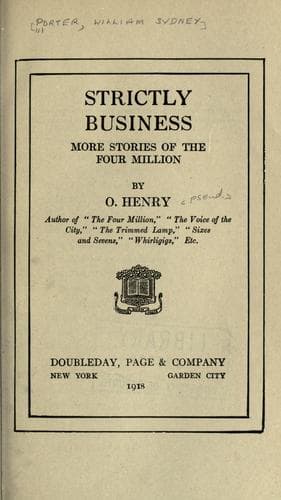
Strictly Business: More Stories of the Four MillionHenry, O.
Philosophy
Strictly Business: More Stories of the Four Million
Henry, O.
New York (N.Y.) -- Social life and customs -- Fiction
Not long before the beginning of this century, Septimus Kinsolving, an
old New Yorker, invented an idea. He originated the discovery that
bread is made from flour and not from wheat futures. Perceiving that
the flour crop was short, and that the Stock Exchange was having no
perceptible effect on the growing wheat, Mr. Kinsolving cornered the
flour market.
The result was that when you or my landlady (before the war she never
had to turn her hand to anything; Southerners accommodated) bought a
five-cent loaf of bread you laid down an additional two cents, which
went to Mr. Kinsolving as a testimonial to his perspicacity.
A second result was that Mr. Kinsolving quit the game with $2,000,000
prof—er—rake-off.
Mr. Kinsolving’s son Dan was at college when the mathematical
experiment in breadstuffs was made. Dan came home during vacation, and
found the old gentleman in a red dressing-gown reading “Little Dorrit”
on the porch of his estimable red brick mansion in Washington Square.
He had retired from business with enough extra two-cent pieces from
bread buyers to reach, if laid side by side, fifteen times around the
earth and lap as far as the public debt of Paraguay.
Dan shook hands with his father, and hurried over to Greenwich Village
to see his old high-school friend, Kenwitz. Dan had always admired
Kenwitz. Kenwitz was pale, curly-haired, intense, serious,
mathematical, studious, altruistic, socialistic, and the natural foe of
oligarchies. Kenwitz had foregone college, and was learning
watch-making in his father’s jewelry store. Dan was smiling, jovial,
easy-tempered and tolerant alike of kings and ragpickers. The two
foregathered joyously, being opposites. And then Dan went back to
college, and Kenwitz to his mainsprings—and to his private library in
the rear of the jewelry shop.
Four years later Dan came back to Washington Square with the
accumulations of B. A. and two years of Europe thick upon him. He took
a filial look at Septimus Kinsolving’s elaborate tombstone in Greenwood
and a tedious excursion through typewritten documents with the family
lawyer; and then, feeling himself a lonely and hopeless millionaire,
hurried down to the old jewelry store across Sixth Avenue.
Kenwitz unscrewed a magnifying glass from his eye, routed out his
parent from a dingy rear room, and abandoned the interior of watches
for outdoors. He went with Dan, and they sat on a bench in Washington
Square. Dan had not changed much; he was stalwart, and had a dignity
that was inclined to relax into a grin. Kenwitz was more serious, more
intense, more learned, philosophical and socialistic.
Public-domain text, read in full here on John Shaqi.
Reviews
Reviews
No reviews yet
Be the first to share your thoughts on this work.
Join the Discussion
Join the discussion
Sign in to leave a comment or review.
Sign InorCreate an account