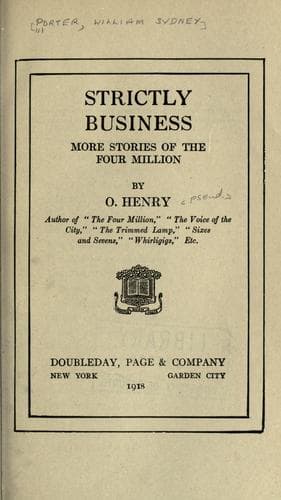
Strictly Business: More Stories of the Four MillionHenry, O.
Philosophy
Strictly Business: More Stories of the Four Million
Henry, O.
New York (N.Y.) -- Social life and customs -- Fiction
And she does it. And there’s no fake blank cartridges or assistants
pulling strings. Helen fires. The bullet—the actual bullet—goes through
the face of the photograph—and then strikes the hidden spring of the
sliding panel in the wall—and lo! the panel slides, and there is the
missing $647,000 in convincing stacks of currency and bags of gold.
It’s great. You know how it is. Cherry practised for two months at a
target on the roof of her boarding house. It took good shooting. In the
sketch she had to hit a brass disk only three inches in diameter,
covered by wall paper in the panel; and she had to stand in exactly the
same spot every night, and the photo had to be in exactly the same
spot, and she had to shoot steady and true every time.
Of course old “Arapahoe” had tucked the funds away there in the secret
place; and, of course, Jack hadn’t taken anything except his salary
(which really might have come under the head of “obtaining money
under”; but that is neither here nor there); and, of course, the New
York girl was really engaged to a concrete house contractor in the
Bronx; and, necessarily, Jack and Helen ended in a half-Nelson—and
there you are.
After Hart and Cherry had gotten “Mice Will Play” flawless, they had a
try-out at a vaudeville house that accommodates. The sketch was a house
wrecker. It was one of those rare strokes of talent that inundates a
theatre from the roof down. The gallery wept; and the orchestra seats,
being dressed for it, swam in tears.
After the show the booking agents signed blank checks and pressed
fountain pens upon Hart and Cherry. Five hundred dollars a week was
what it panned out.
That night at 11:30 Bob Hart took off his hat and bade Cherry good
night at her boarding-house door.
“Mr. Hart,” said she thoughtfully, “come inside just a few minutes.
We’ve got our chance now to make good and make money. What we want to
do is to cut expenses every cent we can, and save all we can.”
“Right,” said Bob. “It’s business with me. You’ve got your scheme for
banking yours; and I dream every night of that bungalow with the Jap
cook and nobody around to raise trouble. Anything to enlarge the net
receipts will engage my attention.”
“Come inside just a few minutes,” repeated Cherry, deeply thoughtful.
“I’ve got a proposition to make to you that will reduce our expenses a
lot and help you work out your own future and help me work out mine—and
all on business principles.”
“Mice Will Play” had a tremendously successful run in New York for ten
weeks—rather neat for a vaudeville sketch—and then it started on the
circuits. Without following it, it may be said that it was a solid
drawing card for two years without a sign of abated popularity.
Sam Packard, manager of one of Keetor’s New York houses, said of Hart &
Cherry:
Public-domain text, read in full here on John Shaqi.
Reviews
Reviews
No reviews yet
Be the first to share your thoughts on this work.
Join the Discussion
Join the discussion
Sign in to leave a comment or review.
Sign InorCreate an account