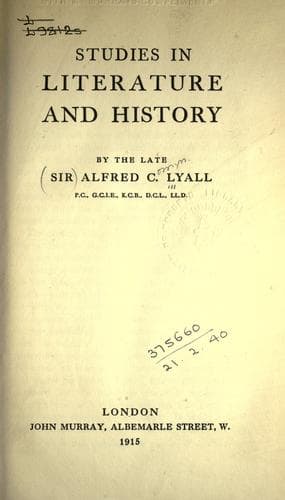
Studies in Literature and HistoryLyall, Alfred C., Sir
Religion
Studies in Literature and History
Lyall, Alfred C., Sir
English literature; History; Literature; Religion; Utilitarianism
Such indeed might be the sentiments of an eager speculator who found
himself among primitive folk. But the discord of ideas puts the whole
piece so completely out of tune as to produce only a harsh and jarring
sensation; the rough Western man is thoroughly out of his element, and
flounders heavily, like a cockney among mediaeval crusaders. This must
be taken in fairness to be the result of collaboration, for in his own
short stories Mr. Kipling never commits solecisms of the kind; on the
contrary, he excels in the shading of strong local colours, and in
the rapid, unerring delineation of characters that stand out in clear
relief, yet blend with and act upon each other when they encounter.
But Mr. Kipling's volumes would require a separate article to
themselves, so that we will merely take this occasion of recording our
wish that he may some day turn his unique faculty of painting real
Indian pictures toward the composition of a novel which shall _not_ be
about Anglo-Indian society (for the thin soil of that field has
already been over-harrowed), but shall give a true and lively
rendering of the thoughts which strike an imaginative Englishman when
he surveys the whole moving landscape of our Indian empire, watches
the course of actual events, and tries to forecast its probable
destiny.
It has been manifestly impossible in this brief article to do more
than touch upon a few books that may illustrate the prominent
characteristics, and the general place in light literature, of Indian
novels. This must explain why we have omitted several other works, of
which _Transgression_[15] is the latest. In this tale we have a sketch
of life on the North-West Frontier at the present day, with some
well-known incidents of the Afridi War of 1897-98 introduced, and so
coloured from the writer's own point of view as to convey, under a
thin varnish of fiction, some sharp and sarcastic criticism on the
management of affairs, the politics of the Government, and the
personal behaviour of certain officials, who can be at once
identified. Although the book is not without interest as a true
account of hazardous and stirring frontier duties, we are bound to
repeat our warning that this abuse of the novel for controversial
purposes is not only unfair, but profoundly inartistic. No literary
success, but failure and the confusion of styles, lies that way.
Public-domain text, read in full here on John Shaqi.
Reviews
Reviews
No reviews yet
Be the first to share your thoughts on this work.
Elsewhere in the archive
Join the Discussion
Join the discussion
Sign in to leave a comment or review.
Sign InorCreate an account