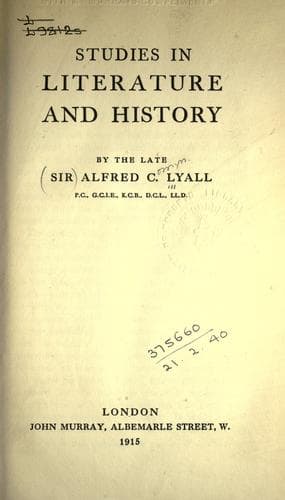
Studies in Literature and HistoryLyall, Alfred C., Sir
Religion
Studies in Literature and History
Lyall, Alfred C., Sir
English literature; History; Literature; Religion; Utilitarianism
What, then, are the conclusions which we may draw from this brief
survey of the more prominent and typical Indian novels? To the
repertory of English fiction, which is perhaps the largest and most
varied that any national literature contains, they have undoubtedly
made a not unworthy contribution; for we may agree that fiction has
some, if not the highest, value when it produces an animated
representation of life and manners, even upon a limited and distant
field. In the present instance the narrow range of plot and character
that may be observed in the pure Anglo-Indian novel reflects the
uniformity of a society which consists almost entirely, outside the
Presidency capitals on the sea-coast, of civil and military
officials--a society that is also upon one level of class and of age,
for among the English in India there are neither old men nor boys and
girls; the men and women are in the prime of life, with a number of
small children. This age-limit lops off from both ends of human
existence a certain proportion of the characters that are available
for filling up the canvas of the social novelist at home. And it is in
truth a peculiar feature, not only of Anglo-Indian society, but of the
Anglo-Indian administration, because the enforced retirement of almost
every officer after the age of fifty-five years greatly diminishes the
influence of weighty and mature experience exercised by the senior men
in the services and government of most countries. In regard to the
equality of class it may be observed that here also the lack of
variety produces a similar dearth of materials; we miss the
picturesque contrasts of rich and poor, of townsfolk and country folk,
of the diverse groups which make up a European population. The 'short
and simple annals of the poor' cannot be woven into the Indian
tapestry which records higher and broader scenes; the peasantry, for
example, whose quaint figures and idioms are so useful in English
novels, do not come into the Anglo-Indian tale. They cannot be blended
in fiction with the foreign element because they are wholly apart in
reality. In short, the whole company that play upon the exclusively
Anglo-Indian stage belong to one grade of society, and the hero is
invariably a military officer.
Public-domain text, read in full here on John Shaqi.
Reviews
Reviews
No reviews yet
Be the first to share your thoughts on this work.
Elsewhere in the archive
Join the Discussion
Join the discussion
Sign in to leave a comment or review.
Sign InorCreate an account