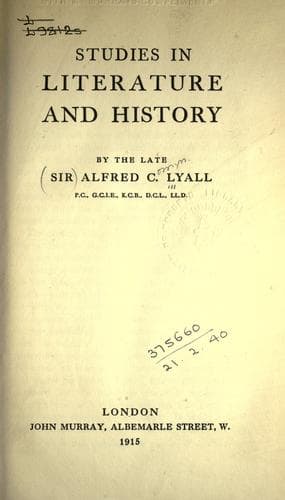
Studies in Literature and HistoryLyall, Alfred C., Sir
Religion
Studies in Literature and History
Lyall, Alfred C., Sir
English literature; History; Literature; Religion; Utilitarianism
The most popular of Anglo-Indian novels are probably those which deal
in exact reproduction of ordinary incidents and conversation, related
in a sprightly and humorous style. This accords with the taste of
present-day readers, many of whom take up a book only for the
momentary amusement that it gives them, and are well content with
interminable dialogues that do little more than echo, with a certain
spice of epigram and smart repartee, the commonplaces interchanged
among clever people at a country house or in a London drawing-room.
Nevertheless, we believe that Anglo-Indian fiction is seen at its best
in the novel of action, since war and love-making must still, as
formerly, rule the whole kingdom of romance; since as emotional forces
they are the same in every climate and country. Each successive
campaign in India, from the first Afghan War to the latest expedition
across the Afridi frontier, has furnished the Anglo-Indian writer with
a new series of striking incidents that can be used for his heroic
deeds and dire catastrophes, for new landscapes and figures, all of
them bearing the very form and stamp of impressive reality. If he is
artist enough to avoid abusing these advantages, if he is neither an
extravagant colourist nor a mere copyist or compiler, he has this
fresh field to himself, he can give us a stirring narrative of
frontier adventures, he can sketch in the aspect of a country or the
distinctive qualities of a people that have preserved many of the
features which in Europe have now vanished into the dim realms of
early romance. His danger lies, as we have seen from some examples
already quoted, in the temptation to make too much use of the
attractive materials that are readily found to hand in military
records or in such a real tragedy as the Sepoy mutiny, so that the
novel is liable to become little more than authentic history related
in a glowing, exuberant style of writing and portraiture.
In short, the Indian novel belongs to the objective outdoor class; it
is full of open air and activity, and the introspective psychological
vein is almost entirely wanting. There are, indeed, passages which
indicate that peculiar sense of the correlation, so to speak, of the
environment with the moods and feelings of men, the influence upon the
human mind of nature--a sense which has inspired some of our finest
poetry, and which is so well rendered by the best Russian novelists,
by Tourgueneff and by Tolstoi. One work of Tolstoi's, _Les Cosaques_,
might be especially recommended for study to the Anglo-Indian novelist
of the future, as an example of the true impress that can be made upon
a reader's mind by the literary art, when it succeeds in giving vivid
interest to the picture of a solitary officer's life upon a dull and
distant frontier.
FOOTNOTES:
Public-domain text, read in full here on John Shaqi.
Reviews
Reviews
No reviews yet
Be the first to share your thoughts on this work.
Elsewhere in the archive
Join the Discussion
Join the discussion
Sign in to leave a comment or review.
Sign InorCreate an account