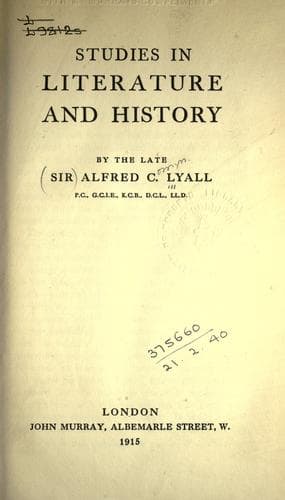
Studies in Literature and HistoryLyall, Alfred C., Sir
Religion
Studies in Literature and History
Lyall, Alfred C., Sir
English literature; History; Literature; Religion; Utilitarianism
[12] (1) _Tara._ By Meadows Taylor. London, 1898. (2) _Oakfield._ By
William D. Arnold. London, 1853. (3) _The Wetherbys, Father and Son._
By John Lang. London, ?1850. (4) _Mr. Isaacs._ By F. Marion Crawford.
London, 1898. (5) _Helen Treveryan._ By John Roy. London, 1892. (6)
_On the Face of the Waters._ By Mrs. Steel. London, 1896. (7) _Bijli
the Dancer._ By James Blythe Patton. London, 1898. (8) _The Chronicles
of Dustypore._ By H. S. Cunningham. London, 1875. And other
Novels.--_Edinburgh Review_, October 1899.
[13] [Greek]
'alla chre ton katathaptein, hos ke thanesi,
nelea thumon echontas, ep hemati hoakrusants.'
(_Iliad_, xix. 228, 229.)
[14] _Naulakha_, by Rudyard Kipling and W. Balestier. London, 1892.
[15] _Transgression_, by S. S. Thorburn. London, 1899.
HEROIC POETRY[16]
I have taken the words 'Heroic Poetry' to signify the poetry of
strenuous action, the art of describing in vigorous animating verse
those scenes and emergent situations in which the energies of mankind
are strung up to the higher tones, and where the emotions are brought
into full play by the exhibition of valour, endurance, and suffering.
It seems to me remarkable that modern English poetry, with all its
splendid variety, should have produced very little in this particular
form; because no one can deny that the latter-day story of the English
has been full of enterprise and perilous adventure, providing ample
material to the artist who knows how to use it. Nor can it be said
that there is any lack of demand for this sort of poetry, and
consequently little inducement to supply it. On the contrary, any one
can see that hero worship is as strong as ever, that any striking
incident, or example of personal valour, or exploit of war, brings out
the verse-writer, and that his efforts, if only very moderately
successful, are sure to win him great popularity.
But it must be admitted that most of these efforts fail rather
lamentably, insomuch that at the present day we may seem to be losing
one of the finest forms of a noble art. From this point of view there
may be some advantage in looking back to the heroic poetry of earlier
ages, and in endeavouring to mark briefly and imperfectly its
distinctive qualities, to recall the conditions and circumstances in
which it flourished, and possibly to hazard some suggestions as to
the causes of its decline.
Public-domain text, read in full here on John Shaqi.
Reviews
Reviews
No reviews yet
Be the first to share your thoughts on this work.
Elsewhere in the archive
Join the Discussion
Join the discussion
Sign in to leave a comment or review.
Sign InorCreate an account