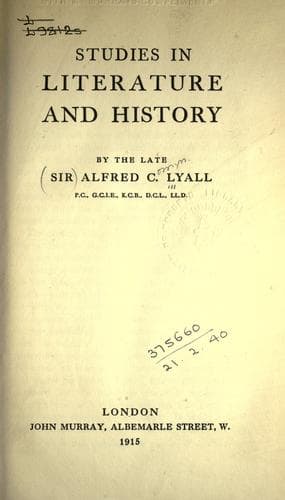
Studies in Literature and HistoryLyall, Alfred C., Sir
Religion
Studies in Literature and History
Lyall, Alfred C., Sir
English literature; History; Literature; Religion; Utilitarianism
I do not know any recent book which throws more light upon this
subject than Professor Ker's book on _Epic and Romance_, published in
1897. It is, to my mind, most valuable as an exposition of the right
nature and methods of heroic narrative, in poetry and in prose. The
author has the rare gift of insight into the ways and feelings of
primitive folk, and the critical faculty of discerning the
characteristics of a style or a period, showing how men, who knew what
to say and the right manner of saying it, have shaped the true form of
heroic poetry. We can see that its elementary principles, the methods
of composition in verse and prose, are essentially the same in all
times and countries, in the _Iliad_, in the Icelandic Sagas, in the
old Teutonic and Anglo-Saxon poems, and to some extent in the French
Chansons de Geste; they might be used to-morrow for a heroic subject
by any one gifted with the requisite skill, imagination, and the eye
for impressive realities.
'Few nations have attained, at the close of their heroic age, to a
form of poetical art in which men are represented freely in action
and conversation. The labour and meditation of all the world has
not discovered, for the purposes of narrative, any essential
modification of the procedure of Homer.'
Professor Ker's essays are a brilliant and scholarly contribution to
the external history of poetical forms: and it would be great
presumption in me to attempt a review of his work. But it is so
eminently suggestive, and to my mind so valuable as a study for verse
writers of the present day, that I have ventured to place this book in
the foreground of an attempt to sketch rapidly some clear outline of
the conditions and the essential qualities of heroic poetry, which is
too commonly regarded as an easy off-hand kind of versification,
largely made up of dash, glowing words, and warlike clatter; although
in reality nothing is more rare or difficult than success in it.
We may say, then, that the first heroic poets and tale-tellers were
those who related the deeds and sufferings, the life and death of the
mighty men of earlier times; and that their verse was the embodiment
of the living traditions of men and manners. They were bards and
chroniclers who lived close enough to the age of which they wrote to
understand and keep touch with it--an age when battles and adventures
were ordinary incidents in the annals of a tribe, a city, or a
country--when valour, skill at arms, and a stout heart were supremely
important, being almost the only virtues that led to high distinction
and a great career. Heroic poetry of the higher kind could not exist
in a period of mere barbarism, for among barbarous folk there is no
art of poetic form. It could not have arisen before the people were so
far civilised as to have among them artistic singers or story-tellers
who gave fine and forcible expression to the acts they celebrated or
the scenes they described.
Public-domain text, read in full here on John Shaqi.
Reviews
Reviews
No reviews yet
Be the first to share your thoughts on this work.
Elsewhere in the archive
Join the Discussion
Join the discussion
Sign in to leave a comment or review.
Sign InorCreate an account