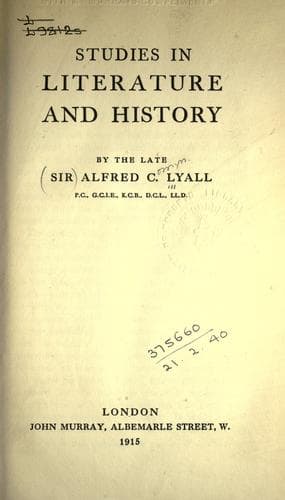
Studies in Literature and HistoryLyall, Alfred C., Sir
Religion
Studies in Literature and History
Lyall, Alfred C., Sir
English literature; History; Literature; Religion; Utilitarianism
It may thus be suggested that the essential quality of Heroic poetry
is this--that it gives a true picture of the time. Not that the poet
was an eye-witness of what he narrated, or even that he lived in the
same generation with the men or the events that he celebrated. On the
contrary, the distance which lends enchantment to the view is needed
to surround heroes with a golden haze of glorification. But the bard
did live on the outer edge, so to speak, of the period which he wrote
about; he was more or less in the same atmosphere; his audience kept
him very near the truth because they could detect any exaggeration,
absurdity, or very unlikely incident; just as we should mark and
reject any particularly foolish story of the war that might appear in
to-morrow's newspaper. They would indeed swallow strange marvels of a
supernatural kind, the doings of gods and goddesses, and of magicians.
But I think it will be agreed that in all ages this has been a
separate matter, because men will believe what is plainly miraculous,
when they will not accept what is merely improbable. So far as the
natural world was concerned, the heroic artist worked upon genuine
material, transmitted orally or by fragmentary records, producing a
right image of remarkable men and the world in which they lived. It
was a world, in most cases, of small communities and petty wars, in
which a good chief or warrior came rapidly to the front, and was
all-important individually.
The word Hero is one of those Greek words which have been adopted into
all European languages, because they signify precisely a universal
idea of the thing. He must be strong and able in battle, for a lost
fight might mean the death or slavery of all his people. If the hero
does his living and dying in a noble fashion, the folk trouble
themselves very moderately about minor questions of religion or
ethics, and are very moderately scandalised by occasional ferocity.
Such a man is not to be hampered by ordinary rules; he is like a
general commanding in the field, who may do anything for the
preservation of his army, and the consequence is that he is seldom
expected to moralise. He acknowledges and pays great honour to the
cardinal virtues of truth-speaking, mutual fidelity, hospitality,
strict observance of pledges. He is in many ways a religious man;
though he is apt to break away from the priests when they interfere
seriously with the business in hand. For the chastity of wives he has
a high esteem, yet although he and his people are constantly brought
into trouble about women, he is tolerant of them, even when their
behaviour is what might be called regrettable; he treats them in some
degree as irresponsible beings, on the ground, perhaps, that they are
the only non-combatants in the world as he knows it, and that this
gives them special privileges. We can measure the importance of such a
personage in ancient days, by the noise which a first-class hero made
in the primitive world.
Public-domain text, read in full here on John Shaqi.
Reviews
Reviews
No reviews yet
Be the first to share your thoughts on this work.
Elsewhere in the archive
Join the Discussion
Join the discussion
Sign in to leave a comment or review.
Sign InorCreate an account