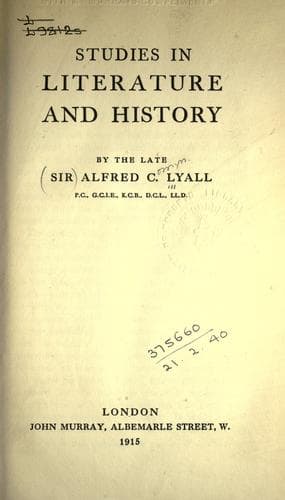
Studies in Literature and HistoryLyall, Alfred C., Sir
Religion
Studies in Literature and History
Lyall, Alfred C., Sir
English literature; History; Literature; Religion; Utilitarianism
He became literally and figuratively immortal:
he was regarded as a god, or at least godlike--the greatest of them
were actually deified. He was seized upon by fable, myth, miraculous
legend, and poetry--his name was handed down for centuries until the
heroic lineaments were softened down, disfigured, and at last faded
away in the magical haze of later Romance. But in very rare instances
he had the good luck to be taken in hand, before it was too late, by
some man of genius, who knew the temper of heroic times because he
lived within range of them, and who has preserved for us a story, an
incident, or a typical character--not, indeed, an authentic narrative,
for the true story disappears under the tradition which is built over
it; nor would such accurate knowledge be of much use to the poet,
whose business it is only to give us a fine spirited account of what
might have occurred. For the evidence that an ancient battle was
really fought we must go to the historian; the poet will tell us how
it was fought, he stirs the blood and fires the imagination by his
tale of noble deeds and deaths. His strength rests upon the foundation
of reality that underlies his artistic construction: he has never let
go his hold upon sound experience: and the truth is felt in all the
colour and detail of the picture, though the whole is a work of vivid
imagination. We cannot verify, obviously, the facts and motives which
led to the siege of Troy, although Herodotus appears to agree that the
cause of that war was a Spartan woman's abduction, and only examines
the point whether the Asiatic or the European Greeks were first to
blame in the matter. Professor Murray prefers to believe in a myth
growing out of the strife of light and darkness in the sky: but the
rape of beautiful girls by seafaring rovers was evidently common
enough in those times, so why should not the Homeric version be right?
We can always be sure that the old poems represent accurately life,
manners, and character; and from the analogy of those legends whose
origin is known, we may fairly infer that the root of a famous story,
divine or human, is first planted in fact, not in fancy; just as the
Chanson de Roland is founded on a real battle in the pass of
Roncevalles.
Public-domain text, read in full here on John Shaqi.
Reviews
Reviews
No reviews yet
Be the first to share your thoughts on this work.
Elsewhere in the archive
Join the Discussion
Join the discussion
Sign in to leave a comment or review.
Sign InorCreate an account