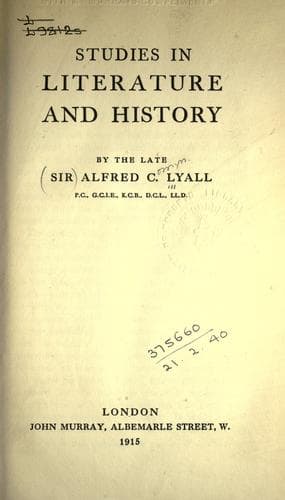
Studies in Literature and HistoryLyall, Alfred C., Sir
Religion
Studies in Literature and History
Lyall, Alfred C., Sir
English literature; History; Literature; Religion; Utilitarianism
Such, therefore, were the conditions and fortunate coincidences which
produced the finest heroic poetry. You had the popular hero--the noble
warrior who knew his business; and you had also the poet or
story-teller who knew his art, could give you a dramatic picture
founded upon fact, and could always keep close to reality, without
crowding his canvas with unnecessary particulars; he gave you the
ruling motives, actions, and feelings of the age. The excellence of
the work lay in simplicity and directness of treatment, in a sureness
of line drawing, in a power of striking the right note, whether of
praise or sorrow, of glory or grief. There is no staginess or
far-fetched emotion, or artificial scene-painting: the style strikes
the right chords of passion or pity, and stamps upon the mind a vivid
impression of situation and character. Moreover, the heroic poet, as a
composer, had this advantage in early days, that continual recital
before an appreciative public must have had the effect of polishing up
his best verses, and polishing off his bad ones. As the theme was
always some well-known story or personage, it was possible to omit
details and explanations, and to go straight to the points that
repetition had proved to be the most effective, so that the criterion
of excellence must have been immediate popularity with the audience as
in a play. It may be conjectured also that the metre, in length of
line and cadence, formed itself to a great degree on the natural
conditions of oral delivery and listening. For all poetry, I think,
makes its primary appeal to the ear; and the modern habit of reading
it seems to me to have thrown this essential test of quality somewhat
into the background. The arrangement of metre and rhyme may have been
gradually invented to correspond with and satisfy that natural
expectation of the recurrence of certain tones and measures which
always delights primitive men, and of which one may possibly trace
some symptoms even in animals, as when the snake sways slowly to the
simple sounds of a snake-charmer's pipe. The order of all modern
versification (except in blank verse, which is never popular) depends
on the echoing rhyme, which marks time like the stroke of a bell, and
is waited for with keen anticipation by the sensitive listener. It is
strange, to my mind, that such a beautiful creation as the beat of
tonic sounds at a line's terminal should have been comparatively so
recent a discovery in European poetry.
Public-domain text, read in full here on John Shaqi.
Reviews
Reviews
No reviews yet
Be the first to share your thoughts on this work.
Elsewhere in the archive
Join the Discussion
Join the discussion
Sign in to leave a comment or review.
Sign InorCreate an account