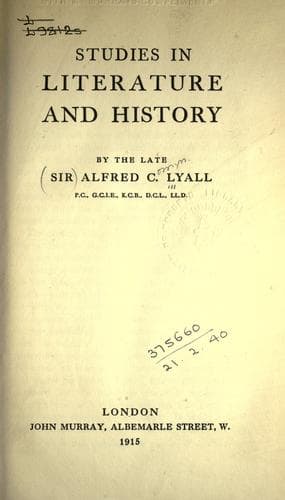
Studies in Literature and HistoryLyall, Alfred C., Sir
Religion
Studies in Literature and History
Lyall, Alfred C., Sir
English literature; History; Literature; Religion; Utilitarianism
Probably the most favourable circumstance for a poet is that he should
only be known, like the Divinity of Nature, from his works; or at
least that, like Wordsworth, he should keep the noiseless tenor of his
way down some secluded vale of life, whereby his poems stand out in
clear relief like fine paintings on a plain wall. Is there any modern
English poet of the first class, except Byron, whose entire prose
writings and biography are bound up in standard editions with his
poetry? The question is at any rate worth asking, because certainly
there is no case in which the record of a poet's private life and
personal fortunes has so greatly affected, for good or for ill, his
poetic reputation. Those who detested his character and condemned his
way of living found it difficult to praise his verses; they detected
the serpent under every stone. For those who were fascinated by the
picture of a reckless prodigal, always in love and in debt, with
fierce passions and a haughty contempt for the world, who defied
public opinion and was suspected of unutterable things--such a
personality added enormous zest to his poetry. But now that Byron's
whole career has been once more laid out before his countrymen, with
light poured on to it from every cranny and peephole, those who take
up this final edition of his life and works must feel that their main
object and duty should be to form an unbiased estimate of the true
value, apart from the author's rank and private history, of poems
which must always hold a permanent place in the high imaginative
literature of England.
Public-domain text, read in full here on John Shaqi.
Reviews
Reviews
No reviews yet
Be the first to share your thoughts on this work.
Elsewhere in the archive
Join the Discussion
Join the discussion
Sign in to leave a comment or review.
Sign InorCreate an account