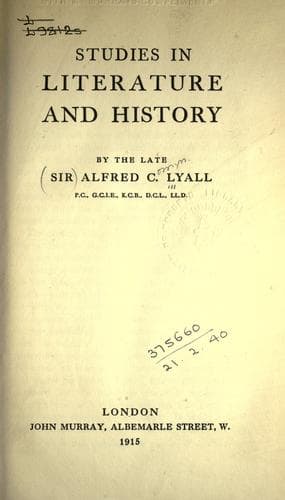
Studies in Literature and HistoryLyall, Alfred C., Sir
Religion
Studies in Literature and History
Lyall, Alfred C., Sir
English literature; History; Literature; Religion; Utilitarianism
It may be said that every writer of force and originality traverses
two phases of opinion before his substantive rank in the great order
of merit is definitely fixed: he is either depressed or exalted
unduly. He may be neglected or cheapened by his own generation, and
praised to the sides by posterity; or his fame may undergo the inverse
treatment, until he settles down to his proper level. Byron's
reputation has passed through sharper vicissitudes than have befallen
most of his compeers; for though no poet has ever shot up in a brief
lifetime to a higher pinnacle of fame, or made a wider impression upon
the world around him, after his death he seems to have declined
slowly, in England, to a point far below his real merits. And at this
moment there is no celebrated poet, perhaps no writer, in regard to
whom the final judgment of critics and men of letters is so
imperfectly determined. Here is a man whom Goethe accounted a
character of unique eminence, with supreme creative power, whose
poetry, he admitted, had influenced his own later verse--one of those
who gave strenuous impulse to the romantic movement throughout
England, France, and Germany in the first quarter of this century, who
set the fashion of his day in England, stirred and shaped the popular
imagination, and struck a far resonant note in our poetry. Yet after
his death he suffered a kind of eclipse; his work was much more unduly
depreciated than it had been extolled; while in our own time such
critics as Matthew Arnold and Mr. Swinburne have been in profound
disagreement on the question of his worth and value as a poet. Nor is
it possible for impartial persons to accept the judgment of either of
these two eminent artists in poetry, since Arnold placed Wordsworth
and Byron by anticipation on the same level at this century's end,
whereas Wordsworth stands now far higher. And the bitter disdain which
Sir. Swinburne has poured upon Byron's verse and character, though
tempered by acknowledgment of his strength and cleverness, and by
approbation of his political views, excites some indignation and a
sympathetic reaction in his favour. One can imagine the ghost of Byron
rebuking his critic with the words of the Miltonic Satan, 'Ye knew me
once no mate For you, there sitting where ye durst not soar'; for in
his masculine defiant attitude and daring flights the elder poet
overtops and looks down upon the fine musical artist of our own day.
Public-domain text, read in full here on John Shaqi.
Reviews
Reviews
No reviews yet
Be the first to share your thoughts on this work.
Elsewhere in the archive
Join the Discussion
Join the discussion
Sign in to leave a comment or review.
Sign InorCreate an account