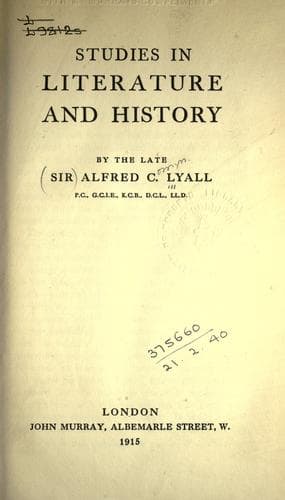
Studies in Literature and HistoryLyall, Alfred C., Sir
Religion
Studies in Literature and History
Lyall, Alfred C., Sir
English literature; History; Literature; Religion; Utilitarianism
Some of the causes which have combined to lower Byron's popularity are
not far to seek. The change of times, circumstance, and taste has been
adverse to him. The political school which he so ardently represented
has done its work; the Tory statesmen of the Metternich and
Castlereagh type, who laid heavy hands upon nations striving for light
and liberty, have gone down to their own place; the period of stifling
repression has long ended in Europe. Italy and Greece are free, the
lofty appeals to classic heroism are out of date, and such fiery
high-swelling trumpet notes as
'Yet, Freedom! yet, thy banner, torn, but flying,
Streams like a thunderstorm _against_ the wind,'
fall upon cold and fastidious ears. 'The day will come,' said Mazzini
in after-years, 'when the democracy will acknowledge its debt to
Byron;' but the demos is notoriously ungrateful, and the subject races
have now won their independence. The shadow of discouragement and
weariness which passed over sensitive minds at the beginning of this
century, a period of political disillusion, has long been swept away
by the prosperity and sanguine activities of the Victorian era; and
the literary style has changed with the times. Melancholy moods,
attitudes of scornful despair, tales of fierce love and bloody revenge
are strange and improbable to readers who delight in situations and
emotions with which they are familiar, who demand exactitude in detail
and correct versification; while sweet harmonies, perfection of metre,
middle-class pastorals, and a blameless moral tone came in with
Tennyson. In short, many of the qualities which enchanted Byron's own
generation have disenchanted our own, both in his works and his life;
for when Macaulay wrote in 1830 that the time would come when his
'rank and private history will not be regarded in estimating his
poetry,' he took no account of future editions enlarged and annotated,
or of biographies of _The Real Lord Byron_; whereby it has come to
pass, as we suspect, that the present world knows more of Byron's
private history than of his poems. His faults and follies stand out
more prominently than ever; his story is more attractive reading than
most romances; and the stricter morality of the day condemns him more
severely than did the society to which he belonged. Psychological
speculation is now so much more practised in literature than formerly,
there is so much more interest in 'the man behind the book,' that
serious moral delinquencies, authentically recorded and eagerly read,
operate more adversely than ever in affecting the public judgment upon
Byron's poetry, because they provide a damaging commentary upon it.
His contemporaries--Coleridge, Keats, Shelley--lived so much apart
from the great world of their day that important changes in manners
and social opinion have made much less difference in the standard by
which their lives are compared with their work. Their poetry,
moreover, was mainly impersonal.
Public-domain text, read in full here on John Shaqi.
Reviews
Reviews
No reviews yet
Be the first to share your thoughts on this work.
Elsewhere in the archive
Join the Discussion
Join the discussion
Sign in to leave a comment or review.
Sign InorCreate an account