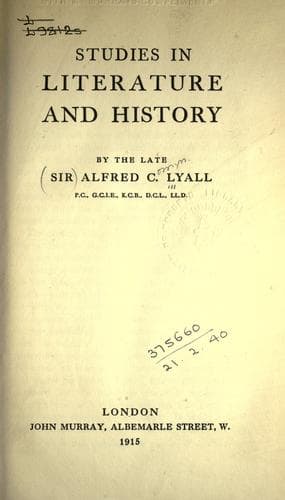
Studies in Literature and HistoryLyall, Alfred C., Sir
Religion
Studies in Literature and History
Lyall, Alfred C., Sir
English literature; History; Literature; Religion; Utilitarianism
These blots, and there are many, become less pardonable when we
observe, from the new edition, that Byron by no means neglected
revision of his work. But his impetuous temper, and the circumstance
of his writing far from the printing-press, encouraged hasty
execution; and though the most true remark that 'easy writing is
devilish hard reading' is his own, though he praised excessively the
chiselled verse of Pope, he was always inclined to pose as one who
threw off jets of boiling inspiration, and in one letter he compares
himself to the tiger who makes or misses his point in one spring. He
ranked Pope first among English poets, yet he learnt nothing in that
school; he pretended to undervalue Shakespeare, yet he must have had
the plays by heart, for his letters bristle with quotations from them.
His avowed taste in poetry is hard to reconcile with his own
performances: his verse was rushing, irregular, audacious, yet he
overpraises the smooth composition of Rogers; he dealt in heroic
themes and passionate love-stories, yet Crabbe's humble pastorals had
their full charm for him. Except Crabbe and Rogers, he declared, 'we
are all--Scott, Wordsworth, Moore, Campbell, and I--upon a wrong
revolutionary poetical system, not worth a damn in itself;' but among
these are some leaders of the great nineteenth-century renaissance in
English verse; and Byron was foremost in the revolt against unnatural
insipidity which has brought us through romance to realism, by his
clear apprehension of natural form and colour, and even by the havoc
which he made among conventional respectabilities. He dwelt too
incessantly upon his own sorrows and sufferings; and in the gloomy
soliloquies of his dramatic characters we have an actor constantly
reappearing in his favourite part. Yet this also was a novelty to the
generation brought up on the impersonal poetry of the classic school;
and here, again, he is a forerunner of the self-reflecting analytical
style that is common in our own day; for there is a Byronic echo in
the 'divine despair' of Tennyson. The melancholy brooding spirit,
dissatisfied with society and detesting complacency, had for some time
been in the air; it had affected the literature of France and Germany;
Werther, Obermann, and Rene are all moulded on the same type with
Childe Harold; yet Sainte-Beuve rightly says that this identity of
type does not mean imitation--it means that the writers were all in
the same atmosphere. There is everywhere the same reaction against
philosophic optimism and the same antipathy to the ways of mankind 'so
vain and melancholy,' They sought refuge from inborn ennui or
irritability among the mountains, on the sea, or in distant voyages,
and they instinctively embodied these moods and feelings in various
personages of fiction, in the solitary wanderer, in the fierce outlaw,
in the man 'with chilling mystery of mien,' who rails against heaven
and humanity. Their literature, in short, however overcoloured it may
Public-domain text, read in full here on John Shaqi.
Reviews
Reviews
No reviews yet
Be the first to share your thoughts on this work.
Elsewhere in the archive
Join the Discussion
Join the discussion
Sign in to leave a comment or review.
Sign InorCreate an account