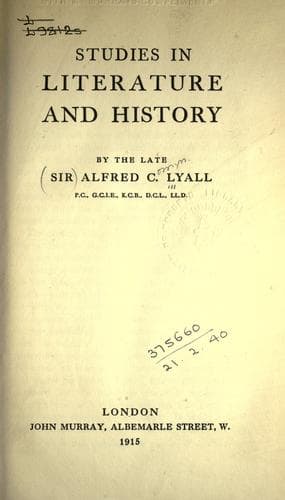
Studies in Literature and HistoryLyall, Alfred C., Sir
Religion
Studies in Literature and History
Lyall, Alfred C., Sir
English literature; History; Literature; Religion; Utilitarianism
This is the large-hearted, far-seeing judgment of one who could survey
the whole line and evolutionary succession of English verse, being
himself destined to close the long list of nineteenth-century poets,
which was opened by Byron and his contemporaries. The time has surely
now come when we may leave discussing Byron as a social outlaw, and
cease groping after more evidence of his misdeeds. The office of true
criticism is to show that he made so powerful an impression on our
literature as to win for himself permanent rank in its annals, and
that his work, with all its shortcomings, does yet mark and illustrate
an important stage in the connected development of our English poetry.
FOOTNOTES:
[24] _The Works of Lord Byron: a New, Revised, and Enlarged
Edition._--'Letters and Journals.' Edited by Rowland E. Prothero, M.
A. 'Poetry.' Edited by Ernest Hartley Coleridge, M. A. London, John
Murray, 1898.--_Edinburgh Review_, October 1900.
[25] Preface to the _Corsair_.
[26] _The Deformed Transformed_ (part I. scene i.).
[27] _Sardanapalus_ (act V. scene i.).
THE ENGLISH UTILITARIANS[28]
Mr. Leslie Stephen combines the faculty of acute and searching
criticism with a style that is singularly clear, incisive, and exact.
His wide knowledge of English literature, and the close study which he
has given to the history of English opinions and controversies,
speculative, political, and economical, have enabled him to survey an
extensive field, to trace the lines of origin and development, to
disentangle complicated ideas, and to summarise conclusions in a
masterly manner. Nearly twenty-five years have passed since he
published his work on _English Thought in the Eighteenth Century_, and
his present book on the Utilitarians continues, and indeed brings down
to our own time, a similar investigation of the course of certain
views, principles, and doctrines which had taken their shape in
England and France during the period preceding the French Revolution,
and which profoundly influenced political discussion throughout the
first half of the nineteenth century. But on this occasion Mr.
Stephen's inquiry does not range over the whole area thus laid open,
though his subject compels him to make several excursions into the
general region of philosophical and political disputation. His main
purpose is to relate the history of a creed propagated by a group of
remarkable men, who took hold of some prominent theories and doctrines
generated by the rationalism of the preceding century, and endeavoured
to make them the basis and framework of a system for improving the
condition of the English people. Their immediate object was to abolish
intolerable abuses of power by the governing classes, and radically to
reform on scientific principles the haphazard blundering
administration which was assumed to be the source of all evil. Mr.
Stephen describes and explains, in short, the rise, progress, and
decay of Utilitarianism.
Public-domain text, read in full here on John Shaqi.
Reviews
Reviews
No reviews yet
Be the first to share your thoughts on this work.
Elsewhere in the archive
Join the Discussion
Join the discussion
Sign in to leave a comment or review.
Sign InorCreate an account