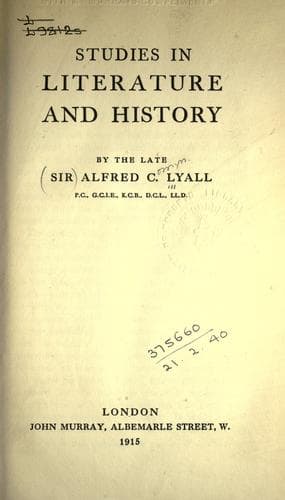
Studies in Literature and HistoryLyall, Alfred C., Sir
Religion
Studies in Literature and History
Lyall, Alfred C., Sir
English literature; History; Literature; Religion; Utilitarianism
Such a system, by its nature and aims, is evidently practical;
it is directed towards a change of laws and an alteration of the
prevailing methods of government. To the philosophic minds of the
eighteenth-century reformers in England and France, it seemed evident,
that any general conclusions upon questions vitally concerning the
interests of mankind should be reached by convincing demonstration,
should start from axioms, and proceed by a connected chain of logical
argument. During the latter half of that century England and France,
so incessantly at war and so different in character and in their
governing institutions, were nevertheless in alliance intellectually.
They were then (with Holland) the only countries in the world where
public opinion had free play, and where discussion of philosophic
problems was actively carried on; and between them there was a
constant interchange of ideas. Now in all speculations, on things
human or divine, there have existed immemorially two schools or
tendencies of thought, two ways of approaching the subject,
corresponding, we may conjecture, to a radical difference of
intellectual predispositions. You may start by the high _a priori_
road, or you may feel your way gradually by induction from verifiable
experiences; and of these two main currents of speculative opinion
whichever is the stronger at any given period will affect every branch
of thought and action. Coleridge appealed to history as proving that
all epoch-making revolutions coincide with the rise or fall of
metaphysical systems, and he attributed the power of abstract theories
over revolutionary movements to the craving of man for higher guidance
than sensations. However this may be, it may be affirmed that the
rationalism of the eighteenth century in England and France found room
by replacing the decaying theologies and substituting reason for the
traditional authority. This was the period that produced in France the
philosophic conception of abstract humanity, everywhere the same
naturally, with a superficial distinction of circumstances, but
differentiated in the main by bad laws, artificial inequalities, and
social injustice. In France the method of deducing conclusions from
abstract principles concerning the rights of man and the social
compact gained predominance, until they were shaped by Rousseau and
others into the formal indictment of a corrupt society. It was the
point and impulse thus given to very real grievances and irritation
against privilege, that precipitated the French Revolution. Among the
English, on the other hand, their public spirit, the connection of
large classes with national affairs, and their habit of compromise,
had predisposed the leading minds towards cautious views in philosophy
and in politics; and at the century's end their inbred distrust of
abstract propositions as a basis for social reconstruction received
startling confirmation from the tremendous explosion in France.
Public-domain text, read in full here on John Shaqi.
Reviews
Reviews
No reviews yet
Be the first to share your thoughts on this work.
Elsewhere in the archive
Join the Discussion
Join the discussion
Sign in to leave a comment or review.
Sign InorCreate an account