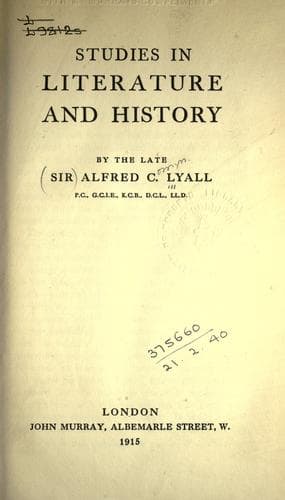
Studies in Literature and HistoryLyall, Alfred C., Sir
Religion
Studies in Literature and History
Lyall, Alfred C., Sir
English literature; History; Literature; Religion; Utilitarianism
The foregoing remarks give in bare outline the conditions and
circumstances, very carefully examined and skilfully analysed by Mr.
Leslie Stephen, that prepared and cleared the ground for the
Utilitarians. Their object was not to reconstruct, hardly to remodel,
existing forms of government; it was to remove abuses, and to devise
remedies for the evils of an unwieldy and complicated administrative
machine, clogged by stupidity and selfishness. And the plan of Mr.
Stephen's first volume is to describe the state of society at this
period, the condition of agriculture and the industries, the position
of the Church and the Universities, of the Army and Navy, the
intellectual tendencies indicated by the philosophic doctrines, and
generally to sketch the political and social aspects of England rather
more than a hundred years ago. He is writing, as he says, the history
of a sect; and in dealing with the tenets of that sect he lays
prominent stress upon what may be called the environment, upon the
various circumstances which may influence forms of belief, and
particularly upon the idiosyncrasies of the men who held and
propagated them. It is for this latter reason that he has given us
brief and interesting biographies of those whose influence was
greatest in shaping and directing the movement, illustrating his
narrative by portraits of them as they lived and acted. All these
things help us towards understanding how it comes to pass that
conclusions which seem clear as daylight to earnest thinkers in one
generation may be abandoned by succeeding generations as manifestly
erroneous. The inquiry also shows why, and to what extent, some of the
doctrines that were scientifically propounded by the Utilitarians did
initiate and lead up to an important reformation in the methods of
English government.
'It might be stated as a paradox' (Mr. Stephen observes) 'that,
whereas in France the most palpable evils arose from the excessive
power of the central government, and in England the most palpable
evils arose from the feebleness of the central government, the
French reformers demanded more government, and the English
reformers less government.... The solution seems to be easy. In
France, reformers such as Turgot and the economists were in favour
of an enlightened despotism, because ... it would suppress the
exclusive privileges of a class which, doing nothing in return, had
become a mere burthen, encumbering all social development. But in
England the privileged class was identical with the governing
class.'
Public-domain text, read in full here on John Shaqi.
Reviews
Reviews
No reviews yet
Be the first to share your thoughts on this work.
Elsewhere in the archive
Join the Discussion
Join the discussion
Sign in to leave a comment or review.
Sign InorCreate an account