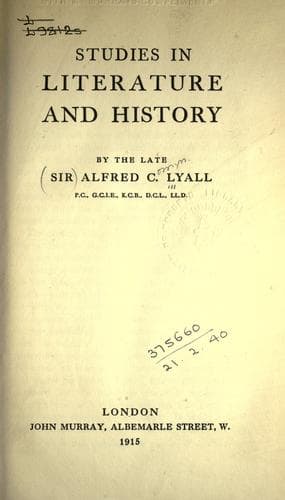
Studies in Literature and HistoryLyall, Alfred C., Sir
Religion
Studies in Literature and History
Lyall, Alfred C., Sir
English literature; History; Literature; Religion; Utilitarianism
In politics, therefore, as well as in philosophy, the prevailing habit
of the English mind was more moderate, less thorough-going and
subversive, than in France. Mr. Stephen makes a keen and rapid
analysis of the common-sense psychology, as expounded by Reid and
Dugald Stewart, to show the correspondence at this period between
abstract reasoning and concrete political views, and to illustrate the
limitations which cautious Scotch professors endeavoured to place upon
the inexorable scepticism of Hume. The general spirit of their
teaching was empirical, but the logical consequence of taking
experience as the sole foundation of belief was evidently to cut off
the hidden springs of moral consciousness, and to support the
derivation of ethics from utility. In philosophy, as in politics,
there was a sympathetic recoil from extremes. So common sense was
brought in as capable of certain intuitive or original judgments which
were in themselves necessary, and which luckily coincided with some of
the firmest convictions among intelligent mankind. As Carlyle said
long afterwards, the Scottish philosophers started from the
mechanical premises suggested by Hume. 'They let loose instinct as an
indiscriminatory bandog to guard them against his conclusions; they
tugged lustily against the logical chain by which Hume was so coldly
towing them and the world into bottomless abysses of atheism and
fatalism.' To save themselves from materialism they invented
Intuitions, and thereby incurred the wrath of orthodox Utilitarianism,
which was rigidly empirical. They were, however, accepted in England,
where any haven was welcome, however uncertain might be the holding
ground, which sheltered the vessel from being blown by windy
speculation out into a shoreless sea.
The Scottish philosophy therefore
'was in philosophy what Whiggism was in politics. Like political
Whiggism, it included a large element of enlightened and liberal
rationalism; but, like Whiggism, it covered an aversion to
thorough-going logic. The English politician was suspicious of
abstract principle, but would cover his acceptance of tradition and
rule of thumb by general phrases about liberty and toleration. The
Whig in philosophy equally accepted the traditional creed,
sufficiently purified from cruder elements, and sheltered his
doctrine by speaking of intuitions and laws of thought.'
Public-domain text, read in full here on John Shaqi.
Reviews
Reviews
No reviews yet
Be the first to share your thoughts on this work.
Elsewhere in the archive
Join the Discussion
Join the discussion
Sign in to leave a comment or review.
Sign InorCreate an account