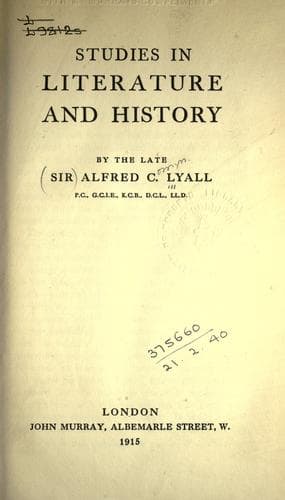
Studies in Literature and HistoryLyall, Alfred C., Sir
Religion
Studies in Literature and History
Lyall, Alfred C., Sir
English literature; History; Literature; Religion; Utilitarianism
The foregoing quotation may serve to indicate briefly the situation,
in politics and philosophy, at the time when Bentham, 'the patriarch
of the English Utilitarians,' appeared upon the scene. Mr. Stephen's
sketch of his life and doctrines, which occupies the latter half of
the book's first volume, is eminently instructive and often amusing.
He excels in tracing the continuity of ideas, and in showing how they
converge upon the point of view that is gradually reached by some
writer of superior force and activity, who rejects, alters, or uses
them in the process of working out the doctrines of some new school.
It was the spread of philanthropy, of a conscientious fellow-feeling
for those classes of society who suffered from neglect and misrule,
that fostered the movement towards political and social reform. This
feeling was represented in Bentham's celebrated formula, originally
invented by Hutcheson, about 'the greatest happiness of the greatest
number'; and the criterion of utility was laid down as having the
widest possible application to all sorts and conditions of men.
Self-help, individualism, _laisser-faire_, the economic view that each
should be left free to pursue his own interests, were principles
intended to operate for the removal of abuses and the destruction of
unfair privileges: they were promulgated for the relief of humanity at
large, although the system which was built up on them came afterwards
to be denounced as narrow, selfish, and materialistic. These ideas
were undoubtedly congenial to the habits and character of Englishmen,
who, like free men everywhere, had a traditional distrust of strong
and active government, preferring King Log, on the whole, to King
Stork. Inequalities and incomprehensible laws were to be seen in the
course of Nature no less than in the English Constitution; and in
either case a man might rely upon his wits and energy to deal with
them. It might be that the defects in human government could only be
remedied by employing the forces of government to cure them; but if
you began to set going the administrative engine there was no saying
where it might stop. Bentham held all government to be an evil, though
he differed from the modern anarchist in holding it to be a necessary
evil; yet he needed a strong scientific administration for the purpose
of rooting out inveterate abuses. And this was the dilemma that
confronted him. He worked out his solution of the problem by laying
out a whole system of morals and a science of politics, with Utility
as their base and standard, which has profoundly influenced all
subsequent legislation, and led eventually to much more extensive
theories regarding the sphere and duties of government than he himself
would have advocated or approved.
Public-domain text, read in full here on John Shaqi.
Reviews
Reviews
No reviews yet
Be the first to share your thoughts on this work.
Elsewhere in the archive
Join the Discussion
Join the discussion
Sign in to leave a comment or review.
Sign InorCreate an account