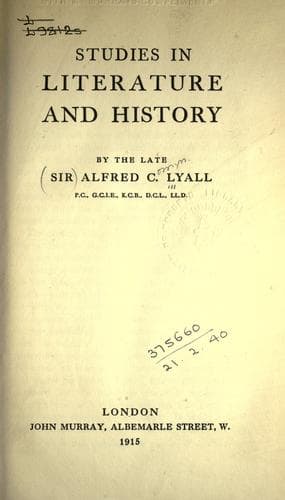
Studies in Literature and HistoryLyall, Alfred C., Sir
Religion
Studies in Literature and History
Lyall, Alfred C., Sir
English literature; History; Literature; Religion; Utilitarianism
and ritual which he treated as obsolete and nonsensical; nor is there
anything more remarkable or unexpected in the political changes of the
last sixty years, than the discomfiture of those prophets who have
foretold the decay of all liturgies and the speedy dissolution of
ecclesiastical establishments. This phenomenon is by no means confined
to England, or even to Europe; and at the present day, when the power
of religious idealism is better understood upon wider experience, no
practical politician attempts to disregard sentiments that defy logic
and pass the understanding.
Nevertheless Utilitarianism, as represented by James Mill's 'Essay on
Government,' was attracting increased attention, and was provoking
serious alarm. It was a period of confidence in theories which have
been partly confirmed and partly contradicted by subsequent
experiences of those 'principles of human nature' in which political
speculators so unreservedly trusted. In France, some fifty years
earlier, the destructive theorist had swept all before him; in
England, while he was assaulting with effect the entrenchments of
Conservatism, he was taken in flank by the moderate reformers. Mill
had denounced the Whigs as half-hearted and even treacherous allies,
who dallied with Radicalism to conceal their nefarious design of
obtaining political mastery with the fewest concessions possible. He
relied upon universal education to qualify the masses for the
possession of an extensive franchise, and upon enlightened
self-interest to guarantee their proper use of it. Macaulay rejoined,
in the _Edinburgh Review_, that the masses might possibly conclude
that they would get more pleasure than pain out of universal
spoliation; and that if his opponent's principles were correct and his
scheme adopted, 'literature, science, commerce, and manufactures might
be swept away, and a few half-naked fishermen would divide with the
owls and foxes the ruins of the greatest of European cities.' It was a
notable controversial tournament, at which the intelligent bystander
probably assisted with much satisfaction and no excessive alarm,
having little faith in the absolute theorist, and not much in the
disinterestedness of the Whigs. For the moment it was sufficient that
both parties agreed in supporting the Reform Bill, although, as Mr.
Stephen remarks, the Radical regarded it as a payment on account,
while the Whig hoped that it would be a full and final discharge. We
may observe, to the honour of a great Liberal family, that as the
first Lord Lansdowne discerned Bentham's talents and gave him his
start in life, so the impression made upon the second marquis by
Macaulay's articles induced him to offer the writer his first seat in
Parliament.
Public-domain text, read in full here on John Shaqi.
Reviews
Reviews
No reviews yet
Be the first to share your thoughts on this work.
Elsewhere in the archive
Join the Discussion
Join the discussion
Sign in to leave a comment or review.
Sign InorCreate an account