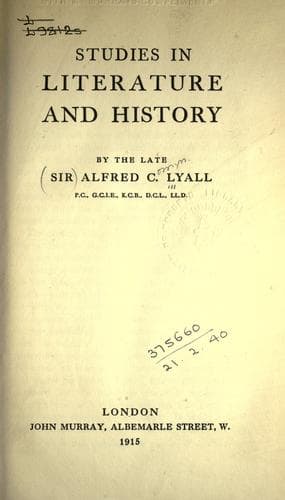
Studies in Literature and HistoryLyall, Alfred C., Sir
Religion
Studies in Literature and History
Lyall, Alfred C., Sir
English literature; History; Literature; Religion; Utilitarianism
Mr. Stephen deals with the duel between Mill and Macaulay from the
standpoint of an impartial umpire, with an expert's appreciation of
their logical fencing and some humorous glances at the heated
combatants. Mill was an austere Puritan, who would fell the Tory like
an ox and would trample upon the cunning self-seeking Whig. The
Edinburgh Reviewers were a set of brilliant young men who represented
intellectual Liberalism; but 'they were men who meant to become
judges, members of Parliament, or even bishops, and nothing in their
social atmosphere had stimulated the deep resentment against social
injustice which makes the fanatic or the enthusiast.' As a sample of
Whiggism Mr. Stephen takes Mackintosh, who, on the subject of the
French Revolution, stood half-way between Burke's holy horror of a
diabolic outburst and the applause of root-and-branch Radicals. For a
type of Conservatism he gives us Robert Southey, whose fortune it was
to be fiercely abused by the Utilitarians and ridiculed by the Whigs.
Southey, like many others, had been frightened out of early Liberalism
into the conviction that Reform would be the inevitable precursor of
revolution; and in 1817 he had written to Lord Liverpool that the only
hope of saving the country lay in gagging the seditious press.
'Concessions,' he said, 'can only serve to hasten the catastrophe. Woe
be to the garrison who hoist a white flag to an enemy that gives no
quarter.' Yet Southey had a deep feeling for the misery of the lower
classes at this period of widespread distress. In his belief in the
power of Government to remedy social evils, he was much nearer the
accepted line of later public opinion than Macaulay, who would have
confined the State's business to the maintenance of order, the defence
of property, and the practice of departmental economy. And when
Southey, following Coleridge and preceding Gladstone, insisted upon
the vital importance of religion as a principle of State policy,
neither he nor Gladstone deserved all the ridicule cast upon them by
Macaulay in his brilliant essays; for at any rate no first-class
Government in Europe has hitherto ventured upon dissolving connection
with the Church.
Public-domain text, read in full here on John Shaqi.
Reviews
Reviews
No reviews yet
Be the first to share your thoughts on this work.
Elsewhere in the archive
Join the Discussion
Join the discussion
Sign in to leave a comment or review.
Sign InorCreate an account