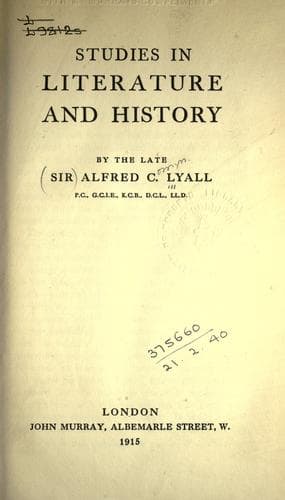
Studies in Literature and HistoryLyall, Alfred C., Sir
Religion
Studies in Literature and History
Lyall, Alfred C., Sir
English literature; History; Literature; Religion; Utilitarianism
For his philosophy, Mr. Stephen tells us, Southey was in the habit of
referring to Coleridge, whose hostility to the Utilitarians went on
different and deeper grounds. Coleridge had convinced himself that all
the errors of the time, and their political dangers, arose from a
false and godless empiricism. He declared that revolutionary periods
have always been connected with the popular prevalence of abstract
ideas, and that the speculative principles of men between twenty and
thirty are the great source of political prophecy. He developed this
view in a singular letter upon the state of affairs and opinions which
he also, like Southey, addressed to Lord Liverpool in 1817, and which
somewhat bewildered that veteran statesman. With the moderns, he said,
'nothing grows, all is made'; whereas growth itself is but a disguised
mode of being made by the superinduction of the _jam data_ on the _jam
datum_; and he insisted that 'the flux of individuals at any moment in
existence in a country is there for the value of the State, far more
than the State for them, though both positions are true
proportionately.' In other words, Coleridge pressed the evolutionary
view against the sharp set, shortsighted Utilitarian propositions; and
he would have agreed that antiquated prejudices are absurd only to
those who have not looked back to their origin, when they can be found
to proceed in logical order from natural causes. He had not been
always a resolute opponent of the Utilitarian theory of morals; but,
like other philosophers, he had become alarmed at the consequence of
being shut up within the prison of finite senses, and he grasped at
Kant's discovery of the difference between Understanding and Reason,
in order to retire upon a metaphysical basis of religion and morality,
and to withstand the prudential calculus. We are inclined to suggest
that Mr. Stephen, who does little more than glance at Coleridge's
position, has underestimated his influence upon the intellectual
direction of politics in the first half of this century. Coleridge
certainly provided an antidote to the crudity of eager Radicalism in
Church and State, and his ideas may be recognised not only in the
great High Church movement that was stirred up by the Tractarians, but
also in the larger comprehension of the duties and attributes of the
State that has been slowly gaining ground up to our own day.
It is, indeed, the growth and development of English opinion regarding
these public duties and attributes, as it is traced in Mr. Stephen's
book, that forms, in our opinion, its chief value; and we are
reviewing it mainly as a history of political ideas. This is, we
believe, the practical outcome of the increasing feeling of sympathy
between different classes of the community, of a sense of
responsibility, of what is called altruism, of solidarity among all
the diverse interests that have lately characterised our legislation:
Public-domain text, read in full here on John Shaqi.
Reviews
Reviews
No reviews yet
Be the first to share your thoughts on this work.
Elsewhere in the archive
Join the Discussion
Join the discussion
Sign in to leave a comment or review.
Sign InorCreate an account