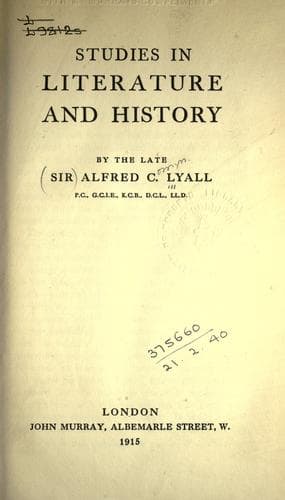
Studies in Literature and HistoryLyall, Alfred C., Sir
Religion
Studies in Literature and History
Lyall, Alfred C., Sir
English literature; History; Literature; Religion; Utilitarianism
In Europe, where, as we have said, all national frontiers are now
fixed and registered, the position of a civilised government entangled
in chronic border warfare has long been unknown; the tradition of such
a state of things is preserved in popular recollection mainly by local
records and old ballads. Yet for Englishmen the subject possesses
peculiar interest, since it is connected with their earlier history;
and moreover our dominion in India invests it with special importance,
for it is there a matter of immediate experience and active concern.
We may recollect, in the first place, that Britain was an outlying
province of the Roman empire, for at this moment we are excavating the
ruins of the wall built by the Romans to protect their northern
frontier from the incursions of the warlike tribes beyond it, by the
first administration that established, for a time, peace and
civilisation in England. Then, in the middle ages, and long
afterwards, the border between the kingdoms of England and Scotland
which ran northward of the old Roman line, was for centuries the scene
of plundering raids, punitive expeditions, and internecine feuds that
often laid waste the countryside with fire and sword. We may observe,
in this instance, how shifting and indeterminate was the exact
frontier line between the two kingdoms, and how the local fighting,
the inroads from one side or the other, did not necessarily involve a
rupture of their formal relations. The wardens on each side executed
rough justice upon marauding clans; they wasted and slaughtered in
reprisal for raids; the great nobles engaged in a kind of private
warfare; but all this might go on without embroiling the two
governments in a national war. On the western English border the Welsh
hillmen kept the neighbouring counties in continual alarm; and their
chiefs played an important part in the civil wars and rebellions of
England. They were at last quieted by Edward I., who succeeded in
subduing Wales though he failed in Scotland. Lastly, though the union
of the two kingdoms brought peace to the Anglo-Scottish border, the
Highland line along the Forth river still kept up, though in a much
less serious degree, the troubles of a regular government in contact
with restless tribes. Nor was it until the middle of the eighteenth
century that these relics of an archaic condition of society, which
had long ago disappeared in other parts of western Europe, were
finally effaced in Great Britain. Long afterwards, in the nineteenth
century, when the conquest of the Punjab carried the north-western
frontier of British India up to the slopes of the Afghan mountains,
the scene of perpetual strife between a strong settled administration
and turbulent borderers which had passed away on the Tweed or the
Forth, and on the Welsh Marches, reappeared in the districts beyond
the Indus.
Public-domain text, read in full here on John Shaqi.
Reviews
Reviews
No reviews yet
Be the first to share your thoughts on this work.
Elsewhere in the archive
Join the Discussion
Join the discussion
Sign in to leave a comment or review.
Sign InorCreate an account