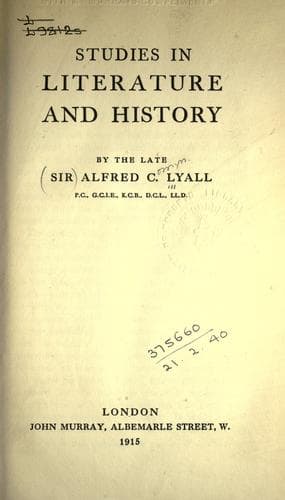
Studies in Literature and HistoryLyall, Alfred C., Sir
Religion
Studies in Literature and History
Lyall, Alfred C., Sir
English literature; History; Literature; Religion; Utilitarianism
In Dr. Pennell's book, the title of which stands at the head of this
article, we have a vivid description, drawn from life, of the names,
habits, and peculiarities of these primitive communities, with many
incidental examples of the relations existing between them and the
British officers who are in touch with them on the frontier. Lord
Roberts, in a short introduction that may be taken as a guarantee of
the accuracy and authenticity of the volume's contents, tells us that
it is a valuable record of sixteen years' good work by a medical
missionary in charge of a mission station at Bannu, on the
north-western frontier of India. And Dr. Pennell's experience,
acquired in the prodigious enterprise of taming and converting to
Christianity some of the most murderous ruffians and inveterate
robbers in Asia, has provided him with a rare insight into their
character, and furnished him with numerous anecdotes of their strange
inconsistencies and wayward, impulsive nature. On the Afghan frontier,
indeed, we may survey a situation that has frequently recurred in the
history of organised governments, whenever they have found themselves
in contact, and therefore in collision, with intractable barbarism.
Immediately across the border line may be seen in the Afridi tribes a
complete and living picture of man in his aboriginal condition of
perpetual war, under no government at all, in daily peril of ending by
a violent death a life that in the pithy words of Hobbes is 'poor,
nasty, brutish, and short.' A few steps back into the British district
brings us among men, often of the same breed and tribe, dwelling
without arms in peace and security, pleading before regular law
courts, learning in English schools, occupied in commerce and industry
under the protection of magistrates and police. The contrast in
morals and manners is as abrupt as the transition from the Afghan
hills to the Indian plains. Such is the frontier along which British
officers are charged with duties of watch and ward. Their business is
to guard the Indian districts that march with the wild borderland, to
prevent or punish incursions by the marauding tribes who have
continued from time immemorial to live in practical anarchy. They obey
no laws and acknowledge no ruler, though in emergencies they appeal
alternately to the Afghan Amir for assistance against the British and
to the British Government against any encroachments by the Amir.
Public-domain text, read in full here on John Shaqi.
Reviews
Reviews
No reviews yet
Be the first to share your thoughts on this work.
Elsewhere in the archive
Join the Discussion
Join the discussion
Sign in to leave a comment or review.
Sign InorCreate an account