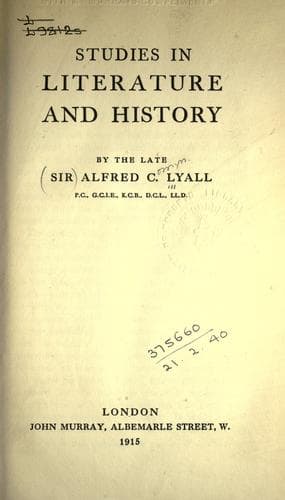
Studies in Literature and HistoryLyall, Alfred C., Sir
Religion
Studies in Literature and History
Lyall, Alfred C., Sir
English literature; History; Literature; Religion; Utilitarianism
Here, in short, we perceive the influence of that very characteristic
school of contemporary art, which we know to have always existed, but
to which men have recently given the exceedingly modern title of
Impressionist,--the school of authors who desire to strike the
imagination vividly and with a few sharp strokes, grouping their
figures in a strong light, rounding off their compact story upon a
small canvas, and rejecting every detail that is not strictly
accessory to the main purpose. Already it is beginning to be said in
France that Zola with his laborious particularism has passed his
climacteric of fashion, and that the swift impressionist is sailing in
on a fair wind of spreading popularity. Now in France, though no
longer in England, the critics still do their duty; they are not
merely, to borrow a phrase from Coleridge, the eunuchs who guard the
temple of the Muses; they are often prolific authors who exercise
great influence upon public opinion, so that their forecast of the
course and tendencies of fiction is worth bearing in mind. We
ourselves are ever a restless, bustling, far-wandering folk, great
lovers of fiction and travel, who not only carry forth the English
language into the uttermost parts of the earth, to be moulded in
strange dialects to queer uses, but also bring back fresh ideas and
incidents, and various aspects of a many-sided world-ranging life. If,
as has been often asserted, literature be the collective expression of
the ideas and aspirations, the tastes, feelings, and habits of the
generation which produces it, we may not be altogether wrong in
treating the short highly finished story, whether of adventure or
manners, as the impress and reflection of modern English society. But
no operation is more delicate than the endeavour to trace the subtle
connection between constant modifications of literary form and the
pressure of its ever-changing moral and material environment.
FOOTNOTES:
[1] The list of these contributions at page 477 of his _Life_ is not
complete.
[2] (1) _The English Novel._ By Walter Raleigh. Being a short Sketch
of its History from the Earliest Times to the Appearance of
'Waverley.' London, 1894. (2) _Aventures de Guerre au temps de la
Republique et du Consulat._ Par A. Moreau de Jonnes. Preface de M.
Leon Say. Paris, Guillaumin et Cie., 1893.--_Quarterly Review_,
October 1894.
[3] Now Sir Walter Raleigh.
[4] Page 179.
[5] _Sense and Sensibility._
[6] _The Art of Illustration_, by Henry Blackburn, 1894.
ENGLISH LETTER-WRITING IN THE NINETEENTH CENTURY[7]
Public-domain text, read in full here on John Shaqi.
Reviews
Reviews
No reviews yet
Be the first to share your thoughts on this work.
Join the Discussion
Join the discussion
Sign in to leave a comment or review.
Sign InorCreate an account